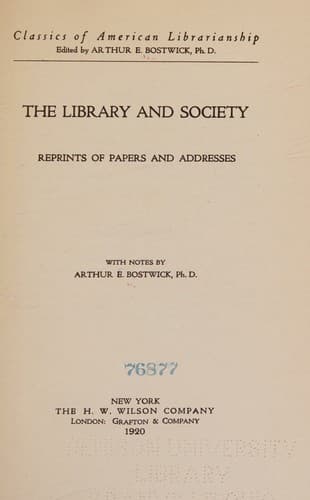
The Library and Society: Reprints of Papers and Addresses
History
The Library and Society: Reprints of Papers and Addresses
Libraries and society; Library science -- Social aspects
By the latest statistics of the Bureau of Education, it appears that
there are 188 public libraries in eleven of the United States. Of these
five are Eastern States--Maine, New Hampshire, Vermont, Massachusetts
and Connecticut; five are Western States--Ohio, Indiana, Illinois,
Wisconsin, and Iowa: and one is a Southern State--Texas. Eight of these
States have passed public-library statutes within the past ten years. In
the number of libraries the States rank as follows: Massachusetts, 127;
Illinois, 14; New Hampshire, 13; Ohio, 9; Maine, 8; Vermont,
Connecticut, and Wisconsin, 4 each; Indiana, 3; Iowa and Texas, 1 each.
In the number of volumes they rank as follows (in round numbers):
Massachusetts, 920,000; Ohio, 144,000; Illinois, 77,000; New Hampshire,
52,000; Maine, 34,000; Indiana, 26,000; Vermont, 16,000; Connecticut,
15,000; Texas, 10,000; Wisconsin, 6000; Iowa, 1000. The aggregate number
of volumes in these libraries is 1,300,000, and their annual aggregate
circulation is 4,735,000 volumes. It is noticeable that no one of these
libraries is in New York, Pennsylvania, or any of the Middle States. The
representatives from those States in this Conference may be able to
account for this hiatus in the statistics of the Bureau of Education.
In this brief sketch of the statistics of our American public libraries
we have not found much evidence of popular objections to their inception
and organization. In England, however, where the questions of national
schools, secular schools, and parochial schools are still mooted, the
idea of levying a general tax for the support of a library free to all,
and furnished with books adapted to the capacities of all classes, was
not in harmony with the traditions and public policy of that people. In
1848, the same year that the Legislature of Massachusetts, at the
suggestion of Josiah Quincy, Mayor of Boston, passed an act authorizing
the city of Boston to maintain a public library, Mr. William Ewart,
member of Parliament, moved in the House of Commons for a committee of
inquiry respecting libraries. Such a committee was raised, and Mr. Ewart
was appointed chairman. Much evidence was taken; a report was made; and
in February, 1850, a bill was introduced into the House of Commons
enabling town councils to establish public libraries and museums. "Our
younger brethren, the people of the United States," says the report,
"have already anticipated us in the formation of libraries entirely open
to the public." The bill proposed limited the rate of taxation to one
halfpenny in the pound; required the affirmative vote of two thirds of
the rate-payers; restricted its operation to towns which had at least
ten thousand inhabitants; and provided that the money so raised should
be expended only in building and contingent expenses. This bill, meagre
indeed compared with the later enactments of Parliament, met persistent
opposition from the conservative benches. An ex-Chancellor of the
Public-domain text, read in full here on John Shaqi.
Reviews
Reviews
No reviews yet
Be the first to share your thoughts on this work.
Elsewhere in the archive
Join the Discussion
Join the discussion
Sign in to leave a comment or review.
Sign InorCreate an account