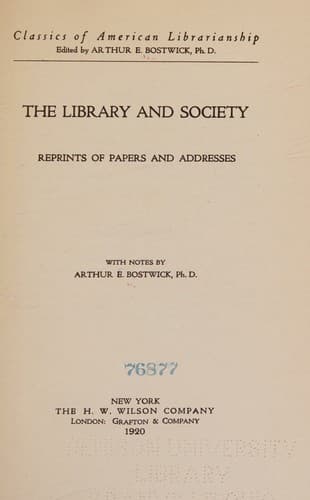
The Library and Society: Reprints of Papers and Addresses
History
The Library and Society: Reprints of Papers and Addresses
Libraries and society; Library science -- Social aspects
In the public libraries which are growing up in our land, fully four
fifths of the money appropriated for books is spent in works adapted to
the wants of scholars. In the larger libraries the proportion is even
greater. It is hardly becoming for scholars, who enjoy the lion's share,
to object to the small proportional expenditure for books adapted to the
wants of the masses who bear the burden of taxation.
Mr. Edward Edwards, of the Manchester Library, speaking, in 1859, of
novels and romances--which he circulated more freely than is done in any
American library--remarked as follows: "It may be truthfully said that
at no previous period in the history of English literature has prose
fiction been made, in so great a degree as of late years, the vehicle of
the best thoughts of some of the best thinkers. Nor, taking it as a
whole, was it ever before characterized by so much general purity of
tone or loftiness of purpose."
HOW TO USE A LIBRARY
The substance of two addresses made at Pittsfield, Mass.,
and printed in _The Library Journal_ for February, 1884. Mr.
Hubbard's advice with regard to children's reading was
followed long ago by specialization in work with children.
That with regard to adult fiction remains unheeded. Some
day, possibly we shall have "adults' librarians" and
training for "work with adults."
James Mascarene Hubbard was born in Boston in 1836. He was
made assistant librarian of the Boston Public Library in
1884 and also reorganized the Berkshire Athenaeum of
Pittsfield, Mass., in the same year.
Among all the pictures of Abraham Lincoln none perhaps are more
interesting than two which represent scenes at the beginning and at the
end of his life. In the first, a lad of thirteen or fourteen, he is
reading by the light of a fire in his father's log hut. In the second,
he is reading the Bible to his sons in a room in the White House. This
Bible, which lies before the President in the latter picture, with a
catechism and a spelling-book, were the only books in that frontier
cabin when he learned to read. Though his father could neither read nor
write, yet he took the greatest interest in getting books for his son,
so that when he was eighteen his library consisted of the Bible,
Pilgrim's Progress, Æsop's Fables, Weem's and Ramsay's Lives of
Washington, a Life of Clay, the Autobiography of Franklin, and a copy of
Plutarch. It is note-worthy that the one which influenced him the most
strongly, after the Bible, was the Life of Washington. At the very
crisis of his career, when on his way to the national capital to take
the leading part in crushing out the rebellion, he reverted to those
early days, and recalled the burning thoughts which filled his mind
while reading of the sufferings and sacrifices endured for the sake of
freedom by the great patriot leader and his followers.
Public-domain text, read in full here on John Shaqi.
Reviews
Reviews
No reviews yet
Be the first to share your thoughts on this work.
Elsewhere in the archive
Join the Discussion
Join the discussion
Sign in to leave a comment or review.
Sign InorCreate an account