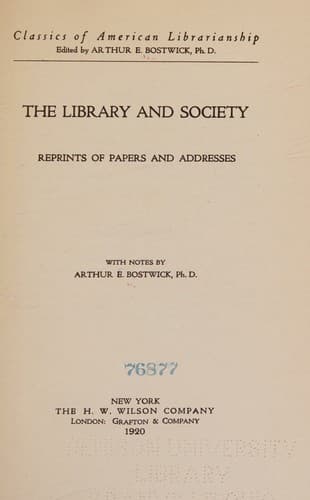
The Library and Society: Reprints of Papers and Addresses
History
The Library and Society: Reprints of Papers and Addresses
Libraries and society; Library science -- Social aspects
Before attempting to aid any one to answer this question for himself,
let me briefly advert to the fact that there are two kinds of reading
for each of us, and two corresponding uses, therefore, of the
library--the reading for amusement and the reading for profit. In regard
to the former, I can say but a word, as it is a subject by itself. And
that word is, let this reading be the best possible, and do not let it
occupy too much of your spare time. Books read simply for amusement have
on most a greater power to elevate or degrade than any others, and more
care should be taken in selecting them than in the choice of those to be
read for instruction. Read then, and put into the hands of the young the
best fiction, and shun those writers, whatever their power or their
popularity, who reproduce in their books the slang and vulgar speech of
the streets and paint realistic scenes of vice and crime.
The answer to the question, How or what shall I read? must necessarily
be as varied as the tastes, the talents, and the circumstances of
readers vary. The general aim, however, should be the same in all. We
should read in order to do well whatever we have to do in life. Now this
implies something more than the reading simply to increase one's
knowledge--certainly a worthy aim, but not the highest. The field of
knowledge is so broad and the time for reading so short that we must
necessarily choose those subjects, the knowledge of which will make us
better fitted for our work in life. And the mere seeking for knowledge,
which is the sole end of much reading, does not imply, but may even
prevent the attaining that higher end, the cultivation of our nobler
powers, as the imagination and the sympathies, and the gaining the power
of appreciating what is highest and best in literature and life. For
instance, one may be conscious of a total lack of a love for any great
writer. To him Homer, Dante, Shakespeare, Milton, and their peers are
but names. Now it may be that the best use to which such an one can put
a library is to make at least the attempt to understand and enjoy some
great author. It will be no easy task, but one needing and worthy the
hardest study. To take, as an illustration of one method, a lesser poet,
read carefully and thoughtfully Matthew Arnold's introduction to his
edition of the selected poems of Wordsworth. Whenever he refers to a
poem, read it before going farther and re-read it until the thought of
the poet as indicated by the commentator is reasonably clear. Then read
in the same manner what Coleridge, Shairp, F.W. Robertson, or any other
good critic has written upon Wordsworth. And, above all, sometimes read
the poems as nearly as possible in the same circumstances under which
they were written--in the forest, by the brook-side, in the solitudes of
the mountains, or on a bridge in the heart of a great city. If this fail
to awaken an interest in Wordsworth, try some other author in a similar
Public-domain text, read in full here on John Shaqi.
Reviews
Reviews
No reviews yet
Be the first to share your thoughts on this work.
Elsewhere in the archive
Join the Discussion
Join the discussion
Sign in to leave a comment or review.
Sign InorCreate an account