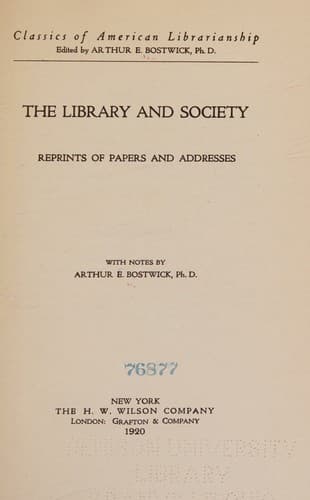
The Library and Society: Reprints of Papers and Addresses
History
The Library and Society: Reprints of Papers and Addresses
Libraries and society; Library science -- Social aspects
And now after this vision of wondrous beauty, this triumph of the grand
arts of architecture and sculpture and landscape--of all the arts, fine
and useful--has for six months enraptured the senses of people from all
quarters of the globe, the learned men of the world have gathered here
to set forth and discuss the fundamental principals that underlie the
sciences, their correlations and the methods of their application to the
arts of life--to summarize the progress of the past, to discuss the
condition of the present and attempt, perhaps, a forecast of the future.
In the scheme of classification, our subject appears in the last
department that concerns itself with man's purely mundane affairs, and
is the last section in that department. It thus appears properly as a
climax and summary of the arts and sciences intelligible to man in his
present stage of existence; and if the problem of the future life is
ever solved this side of the grave, the knowledge conserved and
disseminated by the library will be the starting-point and the
inspiration of the advance, as it has been of all progress since the art
of written speech was invented. "The library is the reservoir of the
common social life of the race. It is at once the accumulator and the
transmitter of social energy." Without the library the highest social
culture is impossible; and a most moderate degree could be achieved by
very few.
Under the main division, "Social Culture," the library is one of the
five sections in the Department of Education. In education are summed up
all the achievements of the past and the possibilities of the future. In
the words of Wendell Phillips, "Education is the one thing worthy the
deep, controlling anxiety of the thoughtful man." "Education," exclaims
Mazzini, "and my whole doctrine is included and summed up in this grand
word." It is practically a truism that Jules Simon utters when he says
"Le peuple qui a les meilleures écoles est le premier peuple; s'il ne
l'est pas aujourd'hui il le sera demain."
Public-domain text, read in full here on John Shaqi.
Reviews
Reviews
No reviews yet
Be the first to share your thoughts on this work.
Elsewhere in the archive
Join the Discussion
Join the discussion
Sign in to leave a comment or review.
Sign InorCreate an account