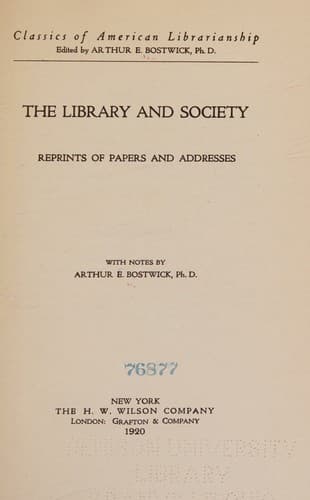
The Library and Society: Reprints of Papers and Addresses
History
The Library and Society: Reprints of Papers and Addresses
Libraries and society; Library science -- Social aspects
I might quote similar utterances from many other eminent educators as to
the value--the necessity--of the library in early education; but I can
think of no stronger summing-up of the subject, nor from higher
authority, than this statement from President Eliot:
"From the total training during childhood there should result in the
child a taste for interesting and improving reading, which should direct
and inspire its subsequent intellectual life. That schooling which
results in this taste for good reading, however unsystematic or
eccentric the schooling may have been, has achieved a main end of
elementary education; and that schooling which does not result in
implanting this permanent taste has failed.... The uplifting of the
democratic masses depends on this implanting at school of the taste for
good reading."
To persons who have given little thought to educational questions these
utterances will have the weight that attaches to the highest authority;
but we need no university president or national commissioner to tell us
these facts. We have learned them from our own experience; and,
enlightened as we now are, it seems to us strange that question could
ever have been raised as to the essential character of the library in
elementary education. Yet there are some of us, I am sure, who can
recall painful consequences from putting into practice an educational
theory not generally accepted by the pedagogues of our childhood days.
We know that higher education is impossible without a library, for the
library is the storehouse of the world's knowledge, the record of
humanity's achievements, the history of mankind's trials and sorrows and
sufferings, of its victories and defeats and of its gradual progress
upwards in spite of frequent fluctuation and failure. In this chronicle
of the past lie lessons for the present and the future; from the lives
of storied heroes comes the inspiration that leads the race onward and
upward. A university without a library would of necessity have a very
small and weak faculty--only the few professors who could be induced to
go where the most important instrumentality of their work was lacking:
the university that has an adequate library includes in its faculty the
professors of all other universities and all the great teachers of all
countries and ages.
But is it worth while to consider a university without a library? Can
there be such an institution?
In higher education, then, the library is a necessity. In elementary
and secondary education it is no less essential, if the most is to be
made of the few years that the average child spends in school and if he
is to be started on a path of self-culture. On this point Stanley Jevons
says:
"In omitting that small expenditure in a universal system of libraries
which would enable young men and women to keep up the three R's and
continue their education, we spend £97 and stingily decline the £3
really needed to make the rest of the £100 effective."
Public-domain text, read in full here on John Shaqi.
Reviews
Reviews
No reviews yet
Be the first to share your thoughts on this work.
Elsewhere in the archive
Join the Discussion
Join the discussion
Sign in to leave a comment or review.
Sign InorCreate an account