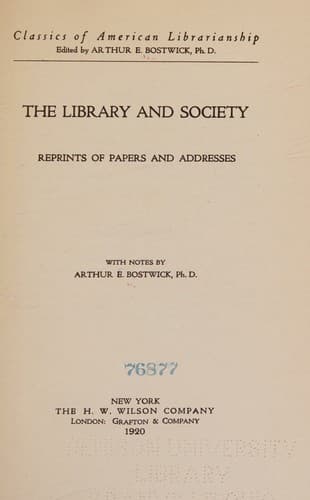
The Library and Society: Reprints of Papers and Addresses
History
The Library and Society: Reprints of Papers and Addresses
Libraries and society; Library science -- Social aspects
The library is primarily to conserve and disseminate knowledge. Indeed,
the old conception of the library was purely that of a place of storage
for written or printed material. No one thought of taking out a book
from a mediaeval library any more than of removing a statue or painting
from an art gallery. And still to-day the function of the library as a
storehouse is most important. Modern democracy holds that knowledge is
not for a few bright minds of each generation, not for an intellectual
elite; but all that is knowable is to be made accessible to all that
desire to know. If we allow knowledge to come only to a chosen few of
each generation, how can we know that we have chosen the right ones to
receive it? The genius that might turn the stream of history may be born
in the lowliest cabin on the prairie, or in the darkest tenement of the
great city. There may not be a village Hampden in every village, but
there may be an Edison, a Fulton, an Eli Whitney, an Andrew Carnegie, a
Carl Schurz in any village in America. Only when we make knowledge
accessible to all shall we know what minds and hearts are among us.
But we must discriminate. The books which no longer convey knowledge,
which state theories no longer held, and propound as facts things no
longer believed; in other words, antiquated books of knowledge should be
sharply separated from books abreast of modern thinking. Those books
which have ceased to be of any use to mankind (except for antiquarian
purposes) or which never were of any use to mankind--and their name is
legion--have their place in a museum, but not in an working library. In
an arsenal we keep only weapons now serviceable in actual war, and
relegate flint-locks, catapults, and bows and arrows to the museum. No
arsenal in the world would be large enough to accommodate weapons for a
modern regiment mingled with all the weapons of all past generations. It
is time for some one to say frankly that there is no inherent sanctity
in paper and printer's ink. It may have been true in Milton's day that a
book was usually the precious life-blood of a master spirit; but to-day
a book is often the product of the least erected spirit that fell. An
almanac put forth to advertise some nostrum, or a novel prepared purely
as a piece of merchandise, does not acquire dignity or value simply
because bound in leather and placed on the shelf with "Paradise Lost."
We must apply to our libraries some higher standard than that of size.
We never estimate the Uffizzi or the Louvre by the number of paintings
they contain, yet we continue to grade modern libraries by the number of
volumes groaning on dust-covered shelves. A library of five thousand
well selected books may be of far more service than one of one hundred
thousand composed largely of books outgrown and forgotten. Our public
libraries must distinguish sharply between the library and the museum,
to the advantage of both.
Public-domain text, read in full here on John Shaqi.
Reviews
Reviews
No reviews yet
Be the first to share your thoughts on this work.
Elsewhere in the archive
Join the Discussion
Join the discussion
Sign in to leave a comment or review.
Sign InorCreate an account