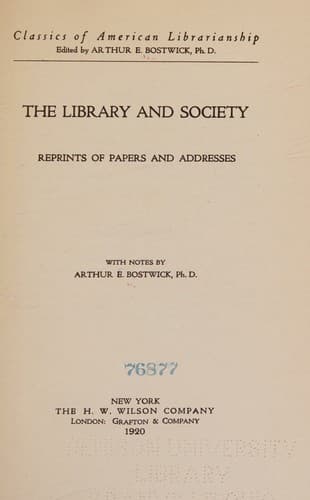
The Library and Society: Reprints of Papers and Addresses
History
The Library and Society: Reprints of Papers and Addresses
Libraries and society; Library science -- Social aspects
The librarian who feels the obligations of his position realizes that
his influence as an educator is far-reaching, telling effectively upon
the community in which he lives, and destined to extend far down the
years to come. It becomes him, therefore, to fully equip himself for his
work, and to give to his constituents the results of his ripest
experience and his most unselfish attention.
THE USEFULNESS OF LIBRARIES IN SMALL TOWNS
A few books in a small town may exert as much influence as
many books in a large one; and the personal influence of
their custodian and administrator may count for more. An
early statement placing emphasis on this fact by Miss West
of the Milwaukee Public Library (now Mrs. Henry L.
Elmendorf) appears in the subjoined paper read at the
Buffalo Conference of the American Library Association in
1883.
Theresa West Elmendorf, who as the writer of this paper was
Theresa Hubbell West, was born at Pardieville, Wis., Nov. 1,
1855, educated in Milwaukee and served on the staff of the
public library of that city, being deputy librarian in
1880-92 and librarian in 1892-96. In that year she married
Henry L. Elmendorf, then librarian of the Buffalo Public
Library, and since his death in 1906 she has been
vice-librarian there. In 1911 she was chosen president of
the American Library Association--the first woman to hold
this office.
There is still, as in the days when the story of the "wicked and
slothful servant," who contemptuously hid his one talent in a napkin,
was told, something discouraging in the sight of incomparably greater
opportunities than our own in the hands of another.
The librarian of a small town or village may not cherish the envy of
the man in the parable in his heart, and yet feel a certain depression,
a sense that the small things he is striving--perhaps with all his
might--to accomplish amount to very little, as he listens to plans for
the construction of a building which will commodiously and conveniently
house two millions of books; as he ponders over a printed scheme which
will intelligently order upon the shelves a hundred thousand volumes,
and is yet so flexible, so elastic, that this number may be indefinitely
increased with no confusion, no necessity for rearrangement; as he sees
a method of charging which has been slowly evolved to meet the
ever-varying, ever-increasing needs of a circulation whose daily issues
are counted by thousands.
Public-domain text, read in full here on John Shaqi.
Reviews
Reviews
No reviews yet
Be the first to share your thoughts on this work.
Elsewhere in the archive
Join the Discussion
Join the discussion
Sign in to leave a comment or review.
Sign InorCreate an account