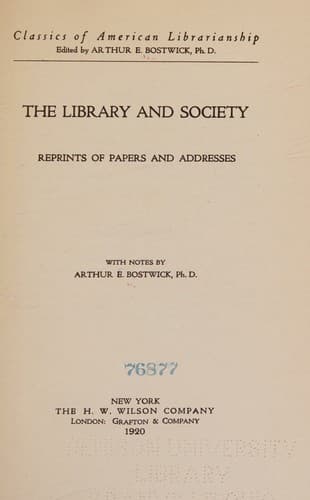
The Library and Society: Reprints of Papers and Addresses
History
The Library and Society: Reprints of Papers and Addresses
Libraries and society; Library science -- Social aspects
One has said that "A library is, after all, very much what its
librarian makes it." There are too many conflicting individualities at
work in a municipal library to make this, to any considerable extent,
true; but in a small town or village the personal equation of the
librarian may easily become the exponent of the power of the library.
ADDRESS AT THE DEDICATION OF THE LIBRARY OF THE UNIVERSITY OF
PENNSYLVANIA
Dr. Talcott Williams, the orator of this occasion, Feb. 7,
1891, was at that time a journalist in Philadelphia. He has
always been a welcome writer and speaker on literary themes.
Talcott Williams was born in Abeih, Turkey, July 20, 1849,
the son of an American missionary. He graduated at Amherst
in 1873 and in that year entered journalism, becoming later
an editorial writer on several large dailies until 1912 when
he was made director of the School of Journalism of Columbia
University, New York City.
For the first and for the last time, the voices of men are heard in
this place, dedicated to the more eloquent silence of books. Nowhere is
man more and men less than in the library. In the presence of books
individual learning pales. The scholar dies; the library lives. Yet only
in part. In this bookish age, we fondly impute immortality to books.
Nothing could be more false. Few books have the power of an endless
life. Against these books of power stand a great multitude of books of
use, which perish with the using. The vast mass of books, like the
thoughts in our daily lives, sink into the background of the
recollection of the race and furnish the soil from which fresh growths
spring. Few there are who have written books of power. Not a score in
all. Poets for the most part. High priests forever after the order of
humanity, whose flaming message burns from age to age in the great tree
of human existence, consuming and unconsumed. These books of power which
live that humanity may not die, and books of use that die that others
may live, divide literature between them. They constitute the warp and
woof out of which the university weaves the higher education. In its
last analysis a liberal training is the mastery of books of use and a
glad yielding to the mastery of books of power.
Public-domain text, read in full here on John Shaqi.
Reviews
Reviews
No reviews yet
Be the first to share your thoughts on this work.
Elsewhere in the archive
Join the Discussion
Join the discussion
Sign in to leave a comment or review.
Sign InorCreate an account