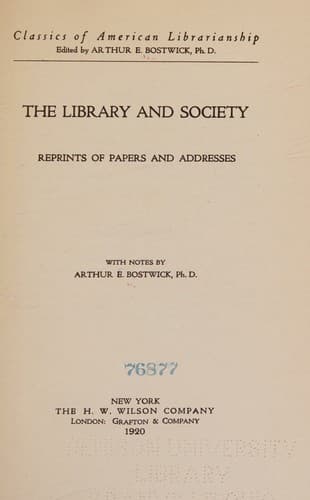
The Library and Society: Reprints of Papers and Addresses
History
The Library and Society: Reprints of Papers and Addresses
Libraries and society; Library science -- Social aspects
Every new book enters the arena about to die. The friendly verdict but
deters fate; it does not avert it. The lesser criticism of letters must
be done anew for every crop of readers, and in fifteen or twenty years
most essays are left behind. The procession of novels passes almost as
rapidly. Few are read for thirty years, no English novels have held a
popular place for past half a century, and a decade before the centenary
of Waverly it begins to be whispered that Scott is no longer read by the
young. Every generation must have its own translations of the classics,
or reprints of those which have been forgotten. Morals, philosophy, and
religion must be rewritten for it. Even histories, which linger a little
longer on the stage than all the rest, yield to inexorable change. It is
barely a century since Gibbon launched his mighty fleet, freighted with
the fall of empire. It has long ridden the seas, but I think we are all
well aware that its masts are already low on the horizon. No one author,
no one work, can longer satisfy the world for the story of ten centuries
of the race. For most of us these changes do not exist. Unconsciously we
go on down the stream with the favorites of our youth and forget that
both are growing old together. If literature is to be taught as it is,
and not as it seems, to take one pregnant illustration, true of all
studies, teacher and taught must have instant and vital access to that
great body of books to which in every subject a text-book is but a rude
and makeshift guide. The present can only be understood by the past, and
both are needed to prophesy of the future. When this library has been
enlarged to the utmost bounds of our anticipation, it will still have
its limits to the specialists--joints in its armor of learning. Even at
the British Museum I was told and discovered that no man is long at work
without wanting some book with which it is unprovided.
But if teaching requires this great array, much more does the wider
work of the college professor. To look upon him as set only to teach, to
hear recitations, is as narrow and barren a view of his work as to think
of the farmer as only occupied in feeding his calves. If a university is
in the highest sense to be a teaching body, it must cultivate knowledge
as well as pupils. Its professors must do more than harvest the learning
and teach the discoveries of other discoverers. They must produce and
discover. The spirit of genius bloweth where it listeth, but those books
of use which play their part in giving each generation its critical
standards, its histories, and the results of research are born only in
full libraries. If a university is deficient in them, the lack is apt to
be in that laboratory of learning, its library. Unless a university is
producing these, it is teaching only its matriculates when it ought to
be teaching the public.
Public-domain text, read in full here on John Shaqi.
Reviews
Reviews
No reviews yet
Be the first to share your thoughts on this work.
Elsewhere in the archive
Join the Discussion
Join the discussion
Sign in to leave a comment or review.
Sign InorCreate an account