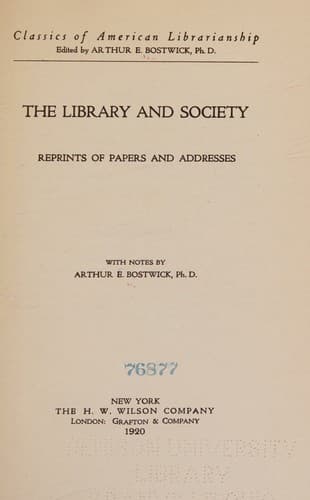
The Library and Society: Reprints of Papers and Addresses
History
The Library and Society: Reprints of Papers and Addresses
Libraries and society; Library science -- Social aspects
But have you ever rightly considered what the mere ability to read
means? That it is the key that admits us to the whole world of thought
and fancy and imagination; to the company of saint and sage, of the
wisest and the wittiest at their wisest and wittiest moment? That it
enables us to see with the keenest eyes, hear with the finest ears, and
listen to the sweetest voices of all time? More than that, it
annihilates time and space for us; it revives for us without a miracle
the Age of Wonder, endowing us with the shoes of swiftness and the cap
of darkness, so that we walk invisible like fern seed and witness
unharmed the plague at Athens or Florence or London, accompanying Cæsar
on his marches, or look in on Catiline in council with his
fellow-conspirators, or Guy Fawkes in the cellar of St. Stephen's. We
often hear of people who will descend to any servility, submit to any
insult, for the sake of getting themselves or their children into what
is euphemistically called good society. Did it ever occur to them that
there is a select society of all the centuries to which they and theirs
can be admitted for the asking--a society, too, which will not involve
them in ruinous expense and still more ruinous waste of time and health
and faculties?
Southey tells us that, in his walk, one stormy day, he met an old
woman, to whom, by way of greeting, he made the rather obvious remark
that it was dreadful weather. She answered, philosophically, that, in
her opinion, '_any_ weather was better than none!' I should be half
inclined to say that any reading was better than none, allaying the
crudeness of the statement by the Yankee proverb, which tells us that,
though 'all deacons are good, there's odds in deacons.' Among books,
certainly there is much variety of company, ranging from the best to the
worst, from Plato to Zola, and the first lesson in reading well is that
which teaches us to distinguish between literature and merely printed
matter. The choice lies wholly with ourselves. We have the key put into
our hands; shall we unlock the pantry or the oratory? There is a
Wallachian legend which, like most of the figments of popular fancy, has
a moral in it. One Bakála, a good-for-nothing kind of fellow in his way,
having had the luck to offer a sacrifice especially well pleasing to
God, is taken up into heaven. He finds the Almighty sitting in something
like the best room of a Wallachian peasant's cottage--there is always
something profoundly pathetic in the homeliness of the popular
imagination, forced, like the princess in the fairy tale, to weave its
semblance of gold tissue out of straw. On being asked what reward he
desires for the good service he has done, Bakála, who had always
passionately longed to be the owner of a bagpipe, seeing a half wornout
one lying among some rubbish in a corner of the room, begs eagerly that
it may be bestowed on him. The Lord, with a smile of pity at the
Public-domain text, read in full here on John Shaqi.
Reviews
Reviews
No reviews yet
Be the first to share your thoughts on this work.
Elsewhere in the archive
Join the Discussion
Join the discussion
Sign in to leave a comment or review.
Sign InorCreate an account