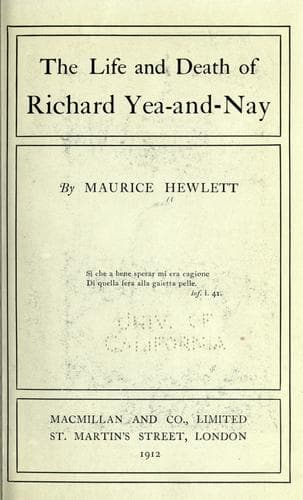
The Life and Death of Richard Yea-and-NayHewlett, Maurice
General
The Life and Death of Richard Yea-and-Nay
Hewlett, Maurice
Richard I, King of England, 1157-1199 -- Fiction
They held a great council there. Richard put out his views. There were
two things to be done: repair Joppa and march at once on Jerusalem,
there to find and have again at Saladin; or pursue the coast road to
Ascalon and raise the siege of that city. 'I, my lords, am for Ascalon,'
Richard said. 'It is the key of Egypt. While the Soldan holds us cooped
up in Ascalon he can get his pack-mules through. If we relieve it, after
the battery we have done him we can hold Jerusalem at our whim. What do
you say to this, Duke of Burgundy?'
In the natural order of things the Duke would have said nothing. But he
had been filled to the neck by Saint-Pol. Richard being for Ascalon, the
key of Egypt, the Duke declared himself for Jerusalem, 'the key,' as he
rather flatly said, 'of the world.' To this Richard contented himself
with replying, that a key was little worth unless you could open the
door with it. All the French stood by their leader, except Des Barres.
He, with Richard's party, leaned to the King's side. But the Duke of
Burgundy would not budge, sat like a lump. He would not go to Ascalon,
and none of his battle should go. Richard cursed all Frenchmen, but gave
in. The truth was, he dared not leave Saint-Pol behind him.
They repaired the walls and towers of Joppa, garrisoned the place. Then
late in the autumn (truthfully, too late) they struck inland over a
rolling grass country towards Blanchegarde, a white castle on a green
hill. Moving slowly and cautiously, they pushed on to Ramleh, thence to
Bêtenoble, which is actually within two days' march of Jerusalem. The
month was October, mellow autumn weather. King Richard, moved by the
sacred influences, the level peace of the fair land, filled day and
night with the thought that he was on the threshold of that soil which
bore the very footmarks of our blessed Saviour--King Richard, I say, was
in great heart. He had been against the enterprise thus to do; he would
have approached from Ascalon; the enterprise was folly. But it was
glorious folly, for which a man might well die. He was ready to die,
though he hoped and believed that he should not. Saladin, once bitten,
would be shy: he had been badly bitten at Arsûf. Then came the Bishop of
Beauvais with Burgundy to his tent--Saint-Pol stayed behind--with
speeches, saying that the winter season was at hand; that it would be
more prudent to withdraw to Joppa, or even to go down to Ascalon.
Ascalon needed succours, it seemed. Richard's heart stood still at this
treachery; then he blazed out in fury. 'Are we hare or hounds, by
heaven? Do you presume--?' He mastered himself. 'What part, pray, does
Almighty God take in these pastimes of yours?'
The Duke of Burgundy looked heavily at the Bishop. The Bishop said,
'Sire, Ascalon is besieged.'
Said Richard, 'You old fool, do you not know the Soldan better than
that? Or do you put him on a parity with this Duke? It was under siege
three weeks ago, as you remember perfectly well.'
Public-domain text, read in full here on John Shaqi.
Reviews
Reviews
No reviews yet
Be the first to share your thoughts on this work.
Elsewhere in the archive
Join the Discussion
Join the discussion
Sign in to leave a comment or review.
Sign InorCreate an account