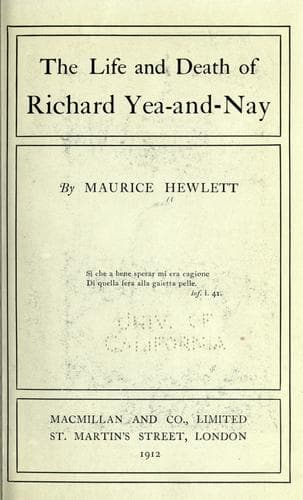
The Life and Death of Richard Yea-and-NayHewlett, Maurice
General
The Life and Death of Richard Yea-and-Nay
Hewlett, Maurice
Richard I, King of England, 1157-1199 -- Fiction
From the haven at Acre to the bill of Tortosa is two days' sailing with
a fair wind. Thence, climbing the mountains, you reach Musse in four
days more, if the passes are open. If they are shut you do not reach it
at all. High on Lebanon, above the frozen gorge where Orontes and
Leontes, rivers of Syria, separate in their courses; above the terrace
of cedars, above Shurky the clouded mountain, lies a deep green valley
sentinelled on all sides by snow peaks and by the fortresses upon their
tops. In the midst of that, among cedars and lines of cypress trees, is
the white palace of the Lord of the Assassins, as big as a town. A man
may climb from pass to pass of Lebanon without striking upon the place;
sighting it from some dangerous crag, he may yet never approach it. None
visit the Old Man of Musse but those who court Death in one of his
shapes; and to such he never denies it. Dazzling snow-curtains, black
hanging-woods, sheer walls of granite, frame it in: looking up on all
sides you see the soaring pikes; and deep under a coffer-lid of blue it
lies, greener than an emerald, a valley of easy sleep. There in the
great chambers young men lie dreaming of women, and sleek boys stand
about the doorways with cups of madness held close to their breasts.
They are eaters and drinkers of hemp, these people, which causes them to
sleep much and wake up mad. Then, when the Old Man calls one or another
and says, Go down the mountains into the cities of the seaboard, and
when thou seest such-a-one, kiss him and strike deep--he goes out then
and there with fixed eyeballs, and never turns them about until he finds
whom he seeks, nor ever shuts them until his work is done. This is the
custom of Musse in the enclosed valley of Lebanon.
Thither on mules from Tortosa came El Safy, leading the Abbot Milo and
Jehane, and brought them easily through all the defiles to that castle
on a spur which is called Mont-Ferrand, but in the language of the
Saracens, Bārin. From that height they looked down upon the domes and
gardens of Musse, and knew that half their work was done.
What immediately followed was due to the insistence of El Safy, who said
that if Jehane was not suitably attired and veiled she would fail of her
mission. Jehane did not like this.
'It is not the custom of our women to be veiled, El Safy,' she said,
'except at the hour when they are to be married.'
'And it is not the custom of our men,' replied the Assassin, 'to choose
unveiled women. And this for obvious reasons.'
'What are your reasons, my son?' asked the abbot.
Public-domain text, read in full here on John Shaqi.
Reviews
Reviews
No reviews yet
Be the first to share your thoughts on this work.
Elsewhere in the archive
Join the Discussion
Join the discussion
Sign in to leave a comment or review.
Sign InorCreate an account