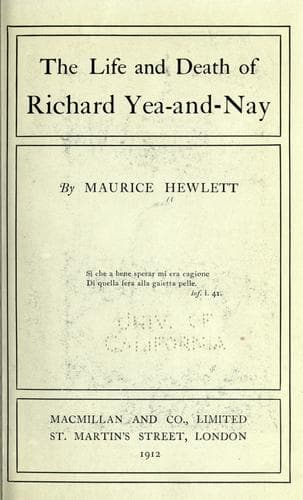
The Life and Death of Richard Yea-and-NayHewlett, Maurice
General
The Life and Death of Richard Yea-and-Nay
Hewlett, Maurice
Richard I, King of England, 1157-1199 -- Fiction
It was not hard to follow back on Martin's dallying footsteps. He traced
him to Venice, to Trieste, up the mountains as far as Blomau. There he
lost him, and shot very wide of the mark. In fact, the slow-witted young
man went to Vienna on a false rumour--but it boots not recount his
wanderings. Six months after he left Ancona, ragged, hatless, unkempt,
hungry, he came within sight of the strong towers of Gratz; and as he
went limping by the town ditch he heard a clear, high voice singing--
Li dous consire
Quem don' Ainors soven--
and knew that he had run down his man.
One other, crouching under the wall, most intent watcher, saw him stop
as if hit, clap his hand to his shock-head, then listen, brooding,
working his jaws from side to side. The voice stayed; Gilles turned and
slowly went his way back. He limped under the gateway into the town, and
the croucher by the wall peered at him between the meshes of her
dishevelled hair.
CHAPTER XI
THE CHAPTER CALLED _A LATERE_
The Old Man of Musse, Lord of all the Assassins, descendant of Ali,
Fulness of Light, Master of them that eat hemp, and many things beside,
wedded Jehane and made her his principal wife. He valued in her, apart
from her bodily perfections, her discretion, obedience, good sense, and
that extraordinary sort of pride which makes its possessor humble, so
inset it is; too proud, you may say, to give pride a thought. Esteeming
her at this price, it is not remarkable if she came to be his only wife.
This was the manner of her life. When her husband left her, which was
very early in the morning, she generally slept for an hour, then rose
and went to the bath. Her boy was brought to her in the pavilion of the
Garden of Fountains; she spent two hours or more with him, teaching him
his prayers, the honour of his father, love and duty to his mother,
respect for the long purposes of God. At ten o'clock she broke her fast,
and afterwards her women sat with her at needlework; and one would sing,
or one tell a good tale; or, leave being given, they would gossip among
themselves, with a look ever at her for approval or (what rarely
happened) disapproval. There was not a soul among her slaves who did not
love her, nor one who did not fear her. She talked no more than she had
ever done, but she judged no less. Many times a day the Old Man sent for
her, or sometimes came to her room, to discuss his affairs. He never
found her out of humour, dull, perverse, or otherwise than well-disposed
to all his desires. Far from that, every Friday he gave thanks in the
mosque for the gift of such an admirable wife--grave, discreet, pious,
amorous, chaste, obedient, nimble, complaisant, and most beautiful, as
he hereby declared that he found her. Being a man of the greatest
possible experience, this was high praise; nor had he been slow in
making up his mind that she was to be trusted. He was about to prove his
deed as good as his opinion.
Public-domain text, read in full here on John Shaqi.
Reviews
Reviews
No reviews yet
Be the first to share your thoughts on this work.
Elsewhere in the archive
Join the Discussion
Join the discussion
Sign in to leave a comment or review.
Sign InorCreate an account