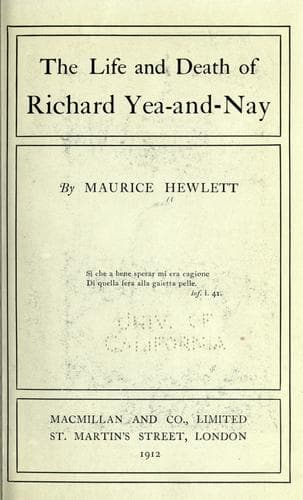
The Life and Death of Richard Yea-and-NayHewlett, Maurice
General
The Life and Death of Richard Yea-and-Nay
Hewlett, Maurice
Richard I, King of England, 1157-1199 -- Fiction
The burning thought of Jehane cut off, sixty feet below him, yet far as
she could ever be, swept across Richard's mind like a roaring wind, and
ridded the room for wilder guests. In came stalking Might-have-been and
No-more, holding each by a shrinking shoulder the delicate maid of his
first delight, Jehane, lissom in a thin gown; Jehane like a bud, with
her long hair alight. Her hair was loose, her face aflame; she was very
young, very much to be kissed, fresh and tall--Oh, God, the mere
loveliness of her! In came the scent of wet stubbles, the fresh salt air
of Normandy, the pale gold of the shaws, the pale sky, the mild October
sun. He felt again the stoop, again the lift of her to his horse, again
the stern ride together; saw again the Dark Tower, and all the love and
sweet pleasure that they made. The bride in the church turning her proud
shy head, the bride in his arm, clinging as they flew, the bride in the
tower, the crowned Countess, the nestling mate--oh, impossibly lost!
Inconceivably put away! Eternally his lover and bride!
Pity, if you can, this lonely heart, this king in chains, this hot
Angevin, son of Henry, son of Geoffrey, son of Fulke, this Yea-and-Nay.
He who dared not look upon the city, lest, seeing, he should risk all
to take it, had now looked upon the bride unaware, and could not touch
her. The fragrance of her, the sacred air in which a loved woman moves,
had floated up to him: his by all the laws of hell, in spite of heaven;
but his no more. Such nearness and such deprivation--to see, to desire,
and not to seize--flung his wits abroad; from that hour his was a lost
soul. Hungry, empty-eyed, ranging, feverish, he lashed up and down his
prison-room, with bare teeth gleaming, and desperate soft strides. No
thought he had but mere despair, no hope but the mere ravin of a beast.
He was across the room in four; he turned, he lunged back; at the wall
he threw up his head, turned and lunged, turned and lunged again. He was
always at it, or rocking on his bed. No hope, nor thought, nor reckoning
had he, but to say Yea against God, Who said him Nay.
So, many times, had he stood, fatal enemy of himself. His Yea would hold
fast while none accepted it, his Nay while no one obeyed. But the supple
knees of men sickened him of his own decree. 'These fools accept my
bidding: the bidding then is foolishness.' So when Fate, so when God,
underwrote his bill, _Le Roy le veult_, he scorned himself and the bill,
and risked wide heaven to make either nought.
Public-domain text, read in full here on John Shaqi.
Reviews
Reviews
No reviews yet
Be the first to share your thoughts on this work.
Elsewhere in the archive
Join the Discussion
Join the discussion
Sign in to leave a comment or review.
Sign InorCreate an account