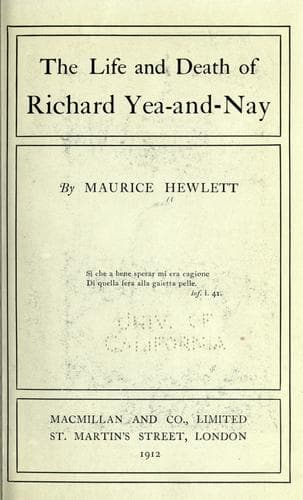
The Life and Death of Richard Yea-and-NayHewlett, Maurice
General
The Life and Death of Richard Yea-and-Nay
Hewlett, Maurice
Richard I, King of England, 1157-1199 -- Fiction
Over those stony ridges and bare fields Don Sancho was king, the seventh
of his name; and he kept his state in the city of Pampluna. Reputed the
wisest prince of his day, it is certain that he had need to be so, such
neighbours as he had. West of him was Santiago, south of him Castile.
These two urgent kings, edging (as it were) on the same bench with him,
made his seat a shifty comfort. No sooner had he warmed himself a place
than he was hoist to a cold one. In front of him, over against the sun,
he saw Philip of France pinched to the same degree between England and
Burgundy, eager to stretch his extremities since he could not broaden
his sides. Don Sancho had no call to love France; but he feared England
greatly--the horrible old brindled Lion, and Richard, offspring of the
Lion and the Pard, Richard the Leopard, who made more songs and fought
more quarrels out than any Christian prince. Here were quodlibets for
Don Sancho's logic. In appearance he was a pale vexed man, with anxious
eyes and a thin beard, at which (in his troubles) he plucked as often as
he could afford the hairs. Next to his bleached lands he loved minstrels
and physicians. Averrhoes was often at his court; so were Guillem of
Cabestaing and Peire Vidal. He knew and went so far as to love Bertran
de Born. Perhaps he was not too good a Christian, certainly he was a
very hungry one; and kings, with the rest of the world, are to be judged
by their necessities, not their professions. So much will suffice, I
hope, concerning Don Sancho the Wise.
In those days which saw Count Richard's back turned on Autafort, and
Saint-Pol's broken at Tours, Bertran de Born came to Pampluna, asking to
be received by the King of Navarre. Don Sancho was glad to see him.
'Now, Bertran,' says he, 'you shall give me news of poets and the food
of poets. All the talk here is of bad debts.'
'Oy, sire,' says Bertran, 'what can I tell you? The land is in flames,
the women have streaked faces, far and wide travels the torch of war.'
'I am sorry to hear it,' says King Sancho, 'and trust that you have not
brought one of those torches with you.'
Bertran shook his head; interruptions worried him, for he lived
maddeningly, like a man that has a drumming in his ear.
'Sire,' he said, 'there is a new strife between the Count of Poictou,
"Yea-and-Nay," and the French King on this account: the Count repudiates
Madame Alois.'
'Now, why does he do that, Bertran?' cried King Sancho, opening his eyes
wide.
'Sire, it is because he pretends that his father, the old King, has done
him dishonour. Says the Count, Madame Alois might be my stepmother,
never my wife.'
'Deus!' said the King. 'Bertran, is this the truth?'
That was a question for which Bertran was fully prepared. He always had
it put, and always gave the same answer. 'As I am a Christian, sire,' he
said, 'the Gospel is no truer.'
Public-domain text, read in full here on John Shaqi.
Reviews
Reviews
No reviews yet
Be the first to share your thoughts on this work.
Elsewhere in the archive
Join the Discussion
Join the discussion
Sign in to leave a comment or review.
Sign InorCreate an account