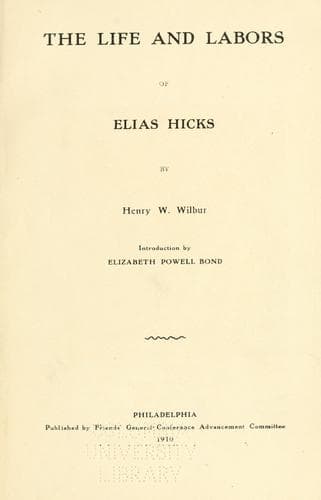
No biography of Elias Hicks could be even approximately adequate which
ignored the division in the Society of Friends in 1827-1828, commonly,
but erroneously, called "the separation." While his part in the trouble
has been greatly exaggerated, inasmuch as he was made the storm-center
of the controversy by his opponents, to consider the causes and
influences which led to the difficulty, especially as they were either
rightly or wrongly made to apply to Elias Hicks, is vital to a study of
his life, and an appreciation of his labors.
We shall not be able to understand the matter at all, unless we can in
a measure take ourselves back to the first quarter of the nineteenth
century, and as far as possible appreciate the thought and life of that
time. We must remember that a system of dogmatic theology, unqualified
and untempered by any of the findings of modern scholarship, was the
central and dominating influence in the religious world. Authority
of some sort was the source of religious belief, and uniformity of
doctrine the basis of religious fellowship.
The aftermath of the French Revolution appeared in a period of
religious negation. Destructive, rather than constructive criticism was
the ruling passion of the unchurched world. The conservative mind was
burdened with apprehension, and the fear of a chaos of faith possessed
the minds of the preachers, the theologians and the communicants of the
so-called Orthodox Christian churches. The Unitarian uprising in New
England had hopelessly divided the historic church of the Puritans,
and the conservative Friends saw in every advance in thought the
breaking up of what they considered the foundations of religion, and
fear possessed them accordingly.
But more important than this is the fact that Friends had largely lost
the historic perspective, touching their own origin. They had forgotten
that their foundations were laid in a revolt against a prevalent
theology, and the evil of external authority in religion. From being
persecuted they had grown popular and prosperous. They therefore
shrank from change in Zion, and from the opposition and ostracism
which always had been the fate of those who broke with approved and
established religious standards. Without doubt they honored the heroism
and respected the sacrifices of the fathers as the "first spreaders
of truth." But they had neither the temper nor the taste to be alike
heroic, in making Quakerism a progressive spirit, rather than a final
refuge of a traditional religion.
Public-domain text, read in full here on John Shaqi.
Reviews
Reviews
No reviews yet
Be the first to share your thoughts on this work.
Elsewhere in the archive
Join the Discussion
Join the discussion
Sign in to leave a comment or review.
Sign InorCreate an account