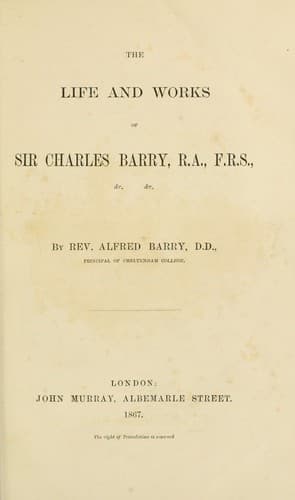
The life and works of Sir Charles BarryBarry, Alfred
General
The life and works of Sir Charles Barry
Barry, Alfred
Architects -- Great Britain -- Biography; Barry, Charles, 1795-1860
The first vote of public money was made on July 3rd, 1837, and the first
portion of the building, the river-wall, was at once proceeded with. The
superintendence of this work was shared by the architect with Mr. James
Walker, the well-known civil engineer. A coffer dam was constructed, and
the foundations of the wall laid upon concrete, which in some places is
as much as twelve feet in thickness. At the very outset of the work
unforeseen difficulties were encountered, and unforeseen expenses
incurred. The soil of the bed of the river was found to be exceedingly
treacherous, in many places little better than a quicksand, and
unfortunately the same character attached to the soil under a large
portion of the building. Great care however was taken with the
foundations, and they were made thoroughly satisfactory; still, as an
additional precaution, Mr. Barry resolved not to draw the piles of the
cofferdam, as had been at first intended, but to cut them off level with
the dredged bed of the river, in order that the lower part of the dam
might remain as a kind of fender or outwork to the wall, protecting it
against the scour of the river, which has in other places proved so
dangerous to the stability of buildings. The wall was faced with large
blocks of Aberdeen granite, and completed in 1839, and meanwhile the
rest of the work proceeded, till it was brought up as nearly as possible
to the level of the terrace on the river wall.
While the foundations were proceeding a commission was appointed to
examine and report upon the various kinds of building stone, and select
one, which should be at once thoroughly durable, and capable of being
worked with tolerable ease and cheapness. The Commissioners were all
distinguished men, Sir Henry (then Mr.) de la Beche, Mr. William Smith,
Mr. C. H. Smith, and the architect. In 1838 they visited all the
best-known quarries, and, after very careful inquiries and experiments,
they presented a Report on March 16th, 1839, recommending the selection
of the magnesian limestone from Bolsover Moor and its neighbourhood. It
was subsequently found that the Bolsover quarries were insufficient to
supply in good condition the large quantity of stone required, and for a
considerable portion of the building a stone of the same general
character (Anston stone) was used.
Well knowing the deleterious effect of the atmosphere (especially the
London atmosphere) on all stone, excepting those which, like granite,
are fit only for works of the most simple and massive design, Mr. Barry
was glad to share the responsibility of the selection with men of high
scientific attainment and reputation. That, in spite of all that care
and science could do, the stone has shown some signs of decay (in a
degree, it may be remarked, greatly exaggerated) is well known; but it
is doubtful whether any other selection would have proved more
fortunate, considering all the requirements of the case.
Public-domain text, read in full here on John Shaqi.
Reviews
Reviews
No reviews yet
Be the first to share your thoughts on this work.
Elsewhere in the archive
Join the Discussion
Join the discussion
Sign in to leave a comment or review.
Sign InorCreate an account