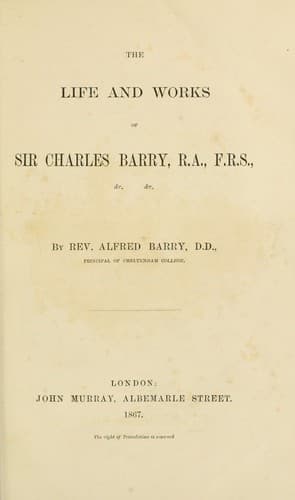
The life and works of Sir Charles BarryBarry, Alfred
General
The life and works of Sir Charles Barry
Barry, Alfred
Architects -- Great Britain -- Biography; Barry, Charles, 1795-1860
It was generally felt at this time that some new system must be adopted
for the warming and ventilating of great public buildings. Hence, the
very novelty and comprehensiveness of Dr. Reid’s plan tended to
recommend it to public notice, in spite of much scepticism on the part
of practical men. Accordingly, in January, 1840, he was formally
appointed at a fixed salary, to superintend the warming and ventilating
of the New Palace. This appointment was made, without any consultation
with the architect, and without any provision whatever as to the
relative subordination of the two authorities thus created. What limit
(if any) should be put to Dr. Reid’s requirements of accommodation in
space and position, how they were to be reconciled with the æsthetic or
constructional character of the design, where the ultimate
responsibility was to lie, if the efficiency of the building were
seriously affected--all these questions were left undetermined. Nor was
any authority provided, to which appeal could be made, if any important
difference of opinion should arise between the architect and ventilator.
Division and disagreement were the inevitable result of this state of
things. In consequence of Dr. Reid’s requirements alterations became
necessary in every quarter of the building. The central tower itself was
originally designed to furnish a great ventilating shaft, though it was
afterwards gladly retained as an architectural feature. Finally it
appeared that about _one-third_ of the whole cubic contents of the
building was to be surrendered to Dr. Reid; and it was the opinion of
Mr. Barry that the construction would be seriously affected by the
ventilating arrangements, and especially that the “fire-proofing”
ordered by the Government was all but nullified.
This led to a decisive rupture,[71] attended of course by much
controversy and mutual recrimination, into which it would now be
needless and improper to enter. The Government determined to refer the
case to professional arbitration; Joseph Gwilt, Esq., was selected as
arbiter. After a long and careful examination of the statements made,
and papers presented by both parties, he made a report in September,
1845, stating his opinion, first, that Dr. Reid’s system, by the use of
vertical flues, destroyed the fireproof character of the building, and,
next, that the delay which had taken place was mainly due to the
division of authority, and the want of detailed drawings explaining Dr.
Reid’s views and requirements. He added a recommendation, that the whole
authority over the building should be restored to the architect, but
that he should be directed to call to his aid some “experts” in
ventilation, and to act by their advice.
Public-domain text, read in full here on John Shaqi.
Reviews
Reviews
No reviews yet
Be the first to share your thoughts on this work.
Elsewhere in the archive
Join the Discussion
Join the discussion
Sign in to leave a comment or review.
Sign InorCreate an account