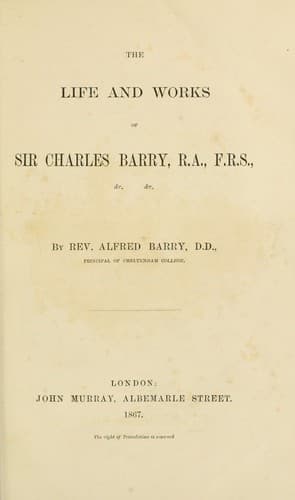
The life and works of Sir Charles BarryBarry, Alfred
General
The life and works of Sir Charles Barry
Barry, Alfred
Architects -- Great Britain -- Biography; Barry, Charles, 1795-1860
As the building advanced, the public attention was drawn to the great
opportunity, which it offered for the encouragement of the arts of
painting and sculpture. His Royal Highness, who frequently visited the
work, and took considerable interest in its progress, was most anxious
that this opportunity should not be lost, and at the same time felt,
that only by great care and consultation of various authorities could it
be used to the best advantage. Accordingly in Nov. 1841 a Royal
Commission (the “Fine Arts Commission”) was appointed, under the
presidency of His Royal Highness, and consisting of the following
members:--Lord Lyndhurst, the Duke of Sutherland, the Marquis of
Lansdowne, Earl of Lincoln, Earl of Shrewsbury, Earl of Aberdeen, Lord
John Russell, Viscount Palmerston, Viscount Melbourne, Lord Ashburton,
Lord Colborne, The Right Hon. Charles Shaw Lefevre (Speaker of the House
of Commons), Sir R. Peel, Sir James Graham, Sir R. H. Inglis, B. Hawes,
Esq. jun., Henry Gale Knight, Esq., Henry Hallam, Esq., S. Rogers, Esq.,
G. Vivian, Esq., Thomas Wyse, Esq. To these were afterwards added the
names of Lord Mahon (now Earl Stanhope), T. B. Macaulay, Esq.
(afterwards Lord Macaulay), Lord Willoughby d’Eresby, Lord Canning, Lord
Morpeth, Sir B. Hall, and the Right Hon. J. Evelyn Denison (Speaker of
the House of Commons), Lord John Manners, and the Hon. W. Cowper. Sir C.
Eastlake was appointed Secretary.
It is obvious, from a glance at the names of the Commissioners, that
great care had been taken to represent on the Board, not only rank and
official knowledge, but also artistic and literary excellence. But it
will be noticed, that the name of the architect of the building does not
occur on the Commission. It was thought, perhaps, that, as having to
carry out the views of the Commission, he ought for technical reasons to
have no seat upon it. It might also have been supposed, that he would be
inclined to look at things too much from one point of view, and
endeavour to subordinate painting and sculpture too much to the
architecture of the building; so that, in the almost inevitable rivalry
of the arts, he would not be a disinterested party. But it may be
questioned whether technical propriety should have been allowed to
override practical convenience. And it is not likely that a single voice
on the Board would have been able to secure to architectural claims more
than their due share of attention.
Public-domain text, read in full here on John Shaqi.
Reviews
Reviews
No reviews yet
Be the first to share your thoughts on this work.
Elsewhere in the archive
Join the Discussion
Join the discussion
Sign in to leave a comment or review.
Sign InorCreate an account