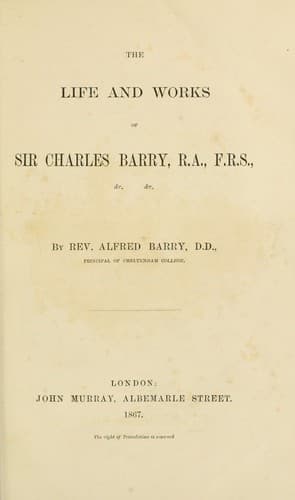
The life and works of Sir Charles BarryBarry, Alfred
General
The life and works of Sir Charles Barry
Barry, Alfred
Architects -- Great Britain -- Biography; Barry, Charles, 1795-1860
A last application was made by Sir C. Barry, in an interview with the
Chancellor of the Exchequer and Mr. Wilson, in which he advanced a plea
that the original 25,000_l._ fixed by Lord Bessborough represented a
percentage, not of three, but of four per cent. The plea was evidently
an unfortunate one, entering as it did on statements, which, from the
nature of the case, it was almost impossible to substantiate with any
certainty, and, moreover, taking the case off the broad grounds on which
it stood, to return to an agreement long since dropped on both sides.
The Treasury were not slow to avail themselves of the advantage thus
given them. In a minute of July 4th, 1856, they again traverse the whole
ground, return to the original bargain, and conclude that Sir C. Barry
has failed to establish his position; they refer to the correspondence
in 1839, and his acceptance under protest of the sum offered, expressing
a doubt (which, except in official circles, has not been generally felt)
“whether they have not taken too liberal a view of the question;” and
state that, as the allowance of one per cent. for measurement, &c.,
applied to some works for which the services of a surveyor were not
ordinarily required, it was more than Sir C. Barry’s due, and should be
considered as giving a full equivalent for any extra services.
It was clear, both from the tenor of this decision and the spirit which
it manifested, that Sir Charles Barry could hope for nothing more from
any friendly negotiation with the Government. Two courses were open to
him. He could have brought the question to a legal issue, standing upon
the vitiation of the original agreement, and the invariable practice of
the profession. Had he been dealing with a private person, he would
undoubtedly have done so; and, in looking back on the question, his
friends are sometimes tempted to regret that he did not do so, even
against Her Majesty’s Government. But there was serious difficulty in
attempting such a course; and he himself was much shaken in health, and
had lost much of the sanguine confidence of earlier days. He could not
hope for much of that support of his claims in Parliament, which is
almost the only influence capable of materially affecting a Government,
nor could he rely on the aid of public opinion. The only other course
was to submit, under protest, to terms which he felt unable any longer
to resist. He addressed accordingly the following letter to the
Treasury:--
“_Old Palace Yard, 15th July, 1856._
“SIR,--I have the honour to acknowledge the receipt of your letter
of the 10th instant, transmitting to me, with reference to my
letter to Mr. Wilson of the 23rd ultimo, a copy of a further Minute
of the Lords Commissioners of Her Majesty’s Treasury, dated the 4th
instant, relative to my remuneration as the architect of the New
Palace at Westminster.
Public-domain text, read in full here on John Shaqi.
Reviews
Reviews
No reviews yet
Be the first to share your thoughts on this work.
Elsewhere in the archive
Join the Discussion
Join the discussion
Sign in to leave a comment or review.
Sign InorCreate an account