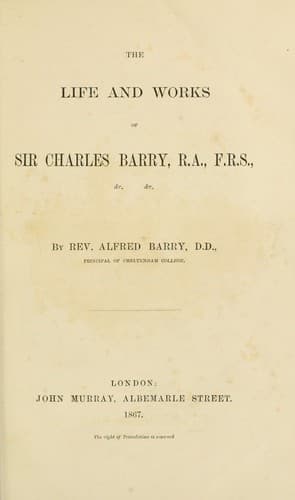
The life and works of Sir Charles BarryBarry, Alfred
General
The life and works of Sir Charles Barry
Barry, Alfred
Architects -- Great Britain -- Biography; Barry, Charles, 1795-1860
The other important features are the three great towers. Of these it is
to be remembered that the central tower was an after-thought,
necessitated by arrangements over which the architect had no control;
otherwise it is possible that, as has been suggested, it would have been
so enlarged as to form a principal feature of the design. It has been a
subject of some surprise, that the general principle of symmetry
followed in the plan and river front, has not been preserved in the case
of the two original towers; but from the very beginning of the design
this was otherwise arranged. The architect probably regarded each as an
almost independent feature, likely to group not with the symmetry of the
river front, but with the necessarily broken line of the land front. In
their design they present a marked contrast, massiveness and grandeur
being the characteristic of the Victoria tower, lightness and elegance
of the clock-tower. Each has its admirers. It is perhaps generally
thought that the clock-tower, from the smallness of its detail,
harmonizes better with the adjacent front, while the Victoria tower,
magnificent in itself, would have tended less to dwarf the rest of the
building, had it stood almost independent of it, connected only by some
grand cloister.
Such is a brief notice of the actual features of the building. The task
of criticism must be left to others. At first very greatly praised, it
was for a time somewhat recklessly condemned. Already it is clear that
it is taking the position due to it. Critics of very opposite schools
show their appreciation, both of the difficulties of the task assigned
to its architect, and the degree of success with which that object has
been attained. Mr. Fergusson, in a vehement anti-Gothic chapter,
regretting that the style of the building was to be Gothic at all,
concludes that, “taking it all in all, it is perhaps the most successful
attempt to apply mediæval architecture to modern civic purposes which
has yet been carried out.” Mr. Scott, in his work on Gothic
architecture, does not hesitate to speak of it as, “on the whole, the
most successful of our modern public buildings.” An article in the
‘Saturday Review,’ immediately after Sir C. Barry’s death, written in
kindliness of feeling, but written also with care and discrimination in
criticism, expresses pretty accurately the verdict of the educated
public taste. “In spite of the shortcomings, which just critical taste
or captious antagonism can find in the details and the mass of the
work,--in spite of the disadvantage of the primary idea of the style in
which it is built having been revolutionised in the course of its
progress--yet the Palace of Westminster stands alone and matchless in
Europe among the architectural monuments of this busy age. From the
border of the Thames, from St. James’s Park or Waterloo Place, from
Piccadilly or the bridge across the Serpentine, the spectacle of that
Public-domain text, read in full here on John Shaqi.
Reviews
Reviews
No reviews yet
Be the first to share your thoughts on this work.
Elsewhere in the archive
Join the Discussion
Join the discussion
Sign in to leave a comment or review.
Sign InorCreate an account