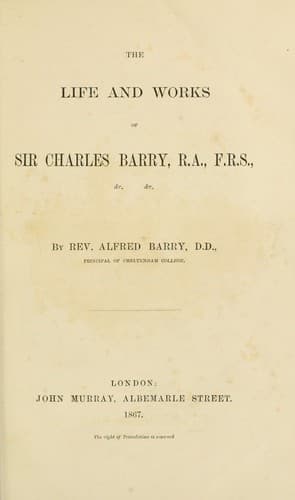
The life and works of Sir Charles BarryBarry, Alfred
General
The life and works of Sir Charles Barry
Barry, Alfred
Architects -- Great Britain -- Biography; Barry, Charles, 1795-1860
The only part of it as yet carried out is the erection of the new church
by the present Duke, in the position indicated by Sir Charles, but from
the designs of Mr. Thomas C. Hine, of Nottingham. Whether any other
portion will be attempted is as yet uncertain. But the plan exists as a
guide for all future work, to be modified, of course, as circumstances
shall dictate. For the want of such plans, both in public and private
buildings, it is lamentable to see how much labour and money are
actually wasted.[108] In this point of view, as well as for its own
grandeur of scheme, the plan for the new house at Clumber may have some
interest to all.
But the great majority of these designs had reference to public
buildings, and to some of these it will be well to refer.
LAW COURTS.--The first design was intended to meet a public need, which
has been long increasing in urgency, and now, after twenty-five years of
discussion, is to be supplied on a scale of unparalleled magnificence.
In 1840 the need of additional accommodation for the Law Courts
attracted the attention of the Government. It was always felt that they
could not remain as they are, insufficient in accommodation, and a mere
excrescence upon Westminster Hall and the New Palace. To enlarge them
was impossible without a serious and unwarrantable encroachment on New
Palace Yard. Therefore, it was concluded that the old associations of
Westminster Hall must be set aside, and the Courts must be removed, and
on the removal Sir C. Barry was consulted. Two sites appeared to him
eligible: one in the centre of Lincoln’s Inn Fields; the other, fronting
the Strand near St. Clement Danes Church, between Lincoln’s Inn and the
Temple. Of these sites the former was clear, and would involve no
expense in the purchase of existing buildings. He believed that the area
occupied would be so small in comparison to the whole, that no serious
injury to one of the “lungs of London” need be apprehended; and, though
he yielded to the outcry, which arose against the scheme, he did not
recognise its justice.
The choice of the other site, instead of interfering with the free
space so highly valuable in London, had undoubtedly the advantage of
clearing away one of the worst of neighbourhoods.[109] To it accordingly
his attention was afterwards directed.
Public-domain text, read in full here on John Shaqi.
Reviews
Reviews
No reviews yet
Be the first to share your thoughts on this work.
Elsewhere in the archive
Join the Discussion
Join the discussion
Sign in to leave a comment or review.
Sign InorCreate an account