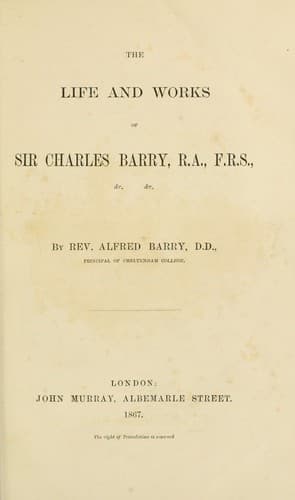
The life and works of Sir Charles BarryBarry, Alfred
General
The life and works of Sir Charles Barry
Barry, Alfred
Architects -- Great Britain -- Biography; Barry, Charles, 1795-1860
It is probable that few will question its grandeur and
comprehensiveness. It would have made Westminster a palatial quarter of
the town, grouping together the buildings, which the public service of a
great country requires, in an unity, justified by their actual unity of
purpose, and all but necessary to their full architectural effect. The
great quadrangle of nine acres, with its sides formed by the Abbey, the
Government Palace, the New Palace of Westminster, and the public
buildings removed in order to clear the area, must have been its most
striking feature. Hardly inferior in magnificence would have been the
Park view of the Government Palace with the enclosed Parade, the large
area cleared along the Thames Embankment, and the great line of public
buildings extending from Great George Street to Trafalgar Square.
Essential points in the scheme were the embankments on both sides of the
river and the large spaces reserved, to be laid out in public gardens,
and so to give breathing space and opportunity for seeing the great
piles of building proposed. Taken altogether it would have produced a
general effect hardly to be equalled in Europe.
But it should also be noticed, that the plan was eminently practical.
It sacrificed little, it indicated the main lines which public
improvements must eventually take, and it was capable of being carried
out gradually. The concentration of public offices is demanded by public
convenience; the opening out the great buildings to be erected will be
an architectural necessity. The Thames Embankment is now a reality,
though Sir Charles would have little dreamt that its effect would have
been allowed to be broken in upon by the Hungerford Railway Bridge, and
the enormous mass of the Charing Cross Station. The enlargement of the
National Gallery is now only a question of time. The opening of great
lines of communication is hardly likely to be long deferred. In the
whole scheme therefore there was nothing visionary, nothing
impracticable.
Its cost no doubt would have been great. But it would not have exceeded
the cost, which will be ultimately incurred; and, if it had been carried
out gradually, the burden on the public resources would have been almost
imperceptible.
In the present state of public feeling as to the value of Art in itself,
and in its influence on the national character, there can be no doubt
that great public improvements will be demanded. The example set in
Paris can hardly be quite lost upon us. Unless unforeseen necessity
should absorb the public resources, great sums of public money will
certainly be expended. That which is to be ardently desired is that the
authorities who direct the public expenditure should have before them
some great and comprehensive scheme, which, while it leaves all details
perfectly free, and so avoids monotonous uniformity, may indicate the
general principles to be followed, and at least see that one improvement
does not destroy or ruin another.
Public-domain text, read in full here on John Shaqi.
Reviews
Reviews
No reviews yet
Be the first to share your thoughts on this work.
Elsewhere in the archive
Join the Discussion
Join the discussion
Sign in to leave a comment or review.
Sign InorCreate an account