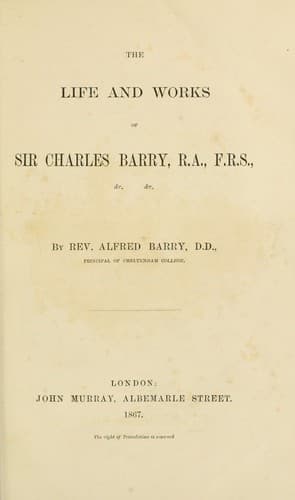
The life and works of Sir Charles BarryBarry, Alfred
General
The life and works of Sir Charles Barry
Barry, Alfred
Architects -- Great Britain -- Biography; Barry, Charles, 1795-1860
ROYAL ACADEMY.--In the work of the Royal Academy he took the greatest
interest, for he had high ideas of what it should attempt in the
guidance and direct inculcation of Art. Being himself a man little
fettered by system, he was quite aware how little academies can kindle
originality of talent, how liable they are to the danger of ignoring or
even discouraging it. He had artistic friends, whose genius he greatly
admired, among those who stood aloof from the Academy, who were the
bitterest denouncers of its actual work, and who would have denied it
even a theoretical value. But he always maintained that it had a most
important sphere, and he contended, that, allowing for the inevitable
defects of all institutions, it was working usefully and
conscientiously in the right path. This being the case, he was anxious
at all times to improve and develope that action still further, so as to
make it, even more than it is, the mainstay and guide of artistic
progress.
It was to his own department of Art that his attention was mainly
directed. This was due, not by any means to a narrow-minded
exclusiveness, for his great desire was that all branches of Art should
be proportionately represented, but to an idea that architecture and
sculpture existed in the Academy almost by sufferance under the
overwhelming predominance of the painters, and that they ought to have a
larger influence and more extensive representation. His own art he
believed to be most comprehensive of all in its scope and requirements,
and at least as powerful as any, in its effects on the taste and
intellectual progress of the country. He was therefore impatient of its
being regarded as holding a secondary position, and having a
quasi-mechanical character. As an Associate, an Academician, and a
member of Council, he laboured at all times to advance its due claims.
More particularly he felt that there was in England a great want of a
more formal and definite architectural education, and this want he
conceived that the Academy ought to supply. In 1856 a large Committee
was formed, with orders to consider how the instruction in the schools
of the Royal Academy could be improved. The subject of Architecture was
delegated to a small sub-Committee, consisting of Messrs. Cockerell and
Hardwick, and Sir C. Barry. Each member of the Committee prepared
suggestions for a scheme of architectural instruction, and these
suggestions were carefully and thoroughly discussed. No result, however,
followed from the time and thought expended on the subject; indeed, the
sub-Committee were fettered by alleged deficiency, both of accommodation
and of funds, for the carrying out of a perfect scheme. They reported
accordingly in favour of an annual grant of 150_l._ for a travelling
studentship, to be held for one year, and gained by competition amongst
the students who had obtained the gold medal. But even this was not
acted upon.
Public-domain text, read in full here on John Shaqi.
Reviews
Reviews
No reviews yet
Be the first to share your thoughts on this work.
Elsewhere in the archive
Join the Discussion
Join the discussion
Sign in to leave a comment or review.
Sign InorCreate an account