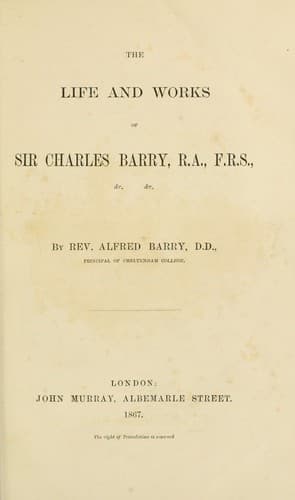
The life and works of Sir Charles BarryBarry, Alfred
General
The life and works of Sir Charles Barry
Barry, Alfred
Architects -- Great Britain -- Biography; Barry, Charles, 1795-1860
ROYAL INSTITUTE OF BRITISH ARCHITECTS.--With this important institution
he was connected from the beginning. In November, 1831, he discussed the
principles of its formation with Professor Donaldson, to whom it has
owed so much, both in its first foundation and its subsequent
development. On December 3rd, 1834, he attended its first meeting, and
records in his diary the completion of its charter on January 17th,
1837. Subsequently he became a Fellow and a Vice-President of the
Institute. On the death of Earl de Grey, when it was decided that the
President’s chair should be occupied by a professional man, it was
offered to him, and it was a subject of great regret to his friends,
that the dislike of publicity, to which reference has already been made,
prevented his acceptance of it. But he recognised the great value of the
Society to the architectural profession, and rejoiced to see its growth
and progress.
He had indeed much reason to feel grateful to the Institute for its
generous appreciation of his position and labours, and for its hearty
support in his time of professional trials. In 1850 he was chosen to
receive the Queen’s Gold Medal, and it was presented to him on June 3rd
by Earl de Grey, the President, who described most truly and skilfully
the peculiar difficulties under which he laboured at the time. In the
painful remuneration controversy, the Institute ventured boldly to
interfere in defence of the architect, and to send to Mr. Wilson the
Resolution which is quoted elsewhere. It was true that he was fighting
the battle of the profession, but it was not the less true, that, on
this very account, the interference of the Institute was likely to be
stigmatised as interested and obtrusive. After his death the council of
the Institute suggested his burial in Westminster Abbey, and sent to his
widow and family an address of hearty and affectionate condolence.
In fact, the whole course of its official proceedings showed, in his
case as in many others, that, in spite of the personal rivalries and of
the differences of styles and principles which are found in all
professions, and perhaps especially in those of an artistic character,
the whole body of architects was ready to show appreciation of work, and
willing to give support and sympathy to one who was devoting to his art
his time, his talents, and his life.
The younger Architectural Society (the Architectural Museum) also
attracted his interest. And in the formation of the Architectural
Publication Society he was willing to give all possible aid. He
contributed to their Architectural Dictionary an article on Baalbec, and
would no doubt have done more, had he lived longer after his retirement
from active work.
Public-domain text, read in full here on John Shaqi.
Reviews
Reviews
No reviews yet
Be the first to share your thoughts on this work.
Elsewhere in the archive
Join the Discussion
Join the discussion
Sign in to leave a comment or review.
Sign InorCreate an account