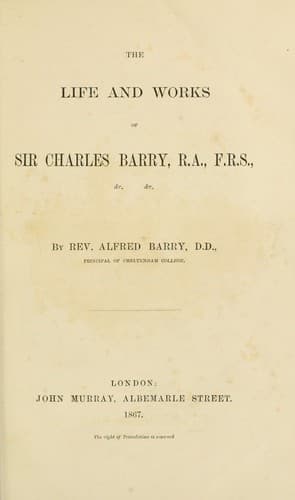
The life and works of Sir Charles BarryBarry, Alfred
General
The life and works of Sir Charles Barry
Barry, Alfred
Architects -- Great Britain -- Biography; Barry, Charles, 1795-1860
The feelings excited by his death naturally gave rise to the desire of
some external memorial of him in the scene of his architectural labours.
The idea was taken up by many, chiefly by his old and kind friends
Professor Donaldson and Mr. Wolfe, and it was warmly aided by the Duke
of Newcastle, the most constant of all his official patrons and
supporters. No monument could be erected in the over-crowded Abbey--a
simple memorial brass has been placed by his family to mark his
resting-place in the nave. Permission was therefore sought and granted
for the erection of a statue in the New Palace. It was desired to place
it in St. Stephen’s Porch, near the point which marks one of the chief
features of the design--the utilisation of Westminster Hall as the grand
entrance to the building, by the splendid arch and staircase at its
southern end. This position, by which the main stream of people flows,
was refused. The only one which could be obtained was at the foot of the
public staircase leading to the upper range of Committee rooms from the
“Witness Hall,” one public enough, but not very central, nor very well
adapted to the exhibition of the statue in itself.
A subscription was opened, in which his family was allowed to take no
part, in order that the memorial might be one from his personal friends
and his professional brethren. The work was entrusted to Mr. Foley. The
result is the statue, which is now placed in the position assigned to
it--admirable as a work of art, and excellent as a representation of the
original. It is the more remarkable, inasmuch as it was not taken from
life, or even from a cast of the face after death. The only materials
were a good bust by Behnes, one or two photographs, and the sculptor’s
own personal recollections. The work which Mr. Foley has produced from
these materials, by the fine outline of the head, and the expression of
vigour and energy in the face, has the merit of giving to strangers the
idea of a man who could deserve and achieve eminence. It has the hardly
inferior merit of bringing back its original very simply and very
effectively to those who knew him.
It is but right that it should find some place in the building to which
he devoted so much labour and skill, for which he gave up so much of his
life. But the principle of the old “Si monumentum quæris, circumspice”
has its application to him also. He can need no monument in
Westminster. His works remain; by them he would have wished to be
judged; to them both now, and even more hereafter, when lapse of time
has given value and solidity to men’s judgment, his reputation may
safely be left.
APPENDIX.
CONTENTS.
(A.) LIST OF ARCHITECTURAL DESIGNS.
(B.) LETTER TO HIS ROYAL HIGHNESS THE PRINCE CONSORT AS
TO THE SOUTH KENSINGTON SCHEME.
Public-domain text, read in full here on John Shaqi.
Reviews
Reviews
No reviews yet
Be the first to share your thoughts on this work.
Elsewhere in the archive
Join the Discussion
Join the discussion
Sign in to leave a comment or review.
Sign InorCreate an account