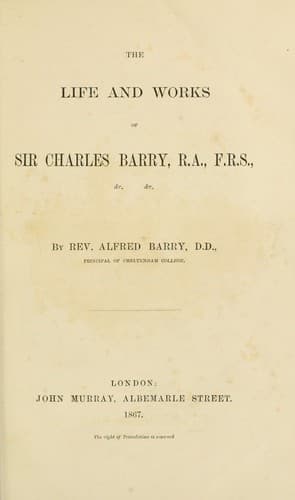
The life and works of Sir Charles BarryBarry, Alfred
General
The life and works of Sir Charles Barry
Barry, Alfred
Architects -- Great Britain -- Biography; Barry, Charles, 1795-1860
HANG
Brief statement of the grounds of difference between the
Architect of the New Palace at Westminster and the
Lords of the Treasury.
1. Because their Lordships have assumed to themselves the right in
their own case to put a value upon the architect’s services, at
variance with professional custom, and contrary both to law and
equity.
2. Because that, whilst the ordinary rate of professional
commission is far from an adequate remuneration for more than 20
years’ devotion of the architect’s life to the carrying into
effect, under peculiarly trying circumstances and great
responsibilities, a work so extensive, intricate, and elaborate, as
the New Palace at Westminster, their Lordships’ offer involves a
sacrifice on his part of at least 20,000_l._ of his accustomed
commission, exclusive of interest of money upon payments unduly
withheld, amounting to not less than 15,000_l._
3. Because the offer made by their Lordships, which is assumed to
be in accordance with precedent, is really at variance with the
allowance hitherto made to architects for all public buildings. For
where they have been employed upon the whole of the duties
undertaken by the architect of the New Palace of Westminster, the
allowance has been _invariably_ 5, and in some instances equal to
more than 5 per cent. upon the expenditure; and although, in some
cases, architects have been paid less than 5 per cent., it is only
when they have been relieved of the financial portion, which is by
no means the least onerous of their duties and responsibilities.
4. Because, with one exception, their Lordships do not recognise
several claims for extra services, which form no part of the duties
of the architect of the New Palace, to which no payment by
commission can apply, and upon which he has incurred a considerable
outlay.
5. Because that, whilst, for the sake of avoiding all further
contention with a Government and affecting an immediate settlement,
the architect had consented to forego his full claims as to
percentage by complying with the principle of their Lordships’
offer, and only awaited their promised explanation of its details,
and an answer relative to a proposition made to them respecting a
portion of his services which had not been recognised, their
Lordships without any further communication with him, framed their
Minute of the 29th January, 1856, containing a decision on the
case, and immediately laid that and a previous Minute on the table
of each House of Parliament, unaccompanied by the correspondence or
any notice of the negotiation which led to them.
Public-domain text, read in full here on John Shaqi.
Reviews
Reviews
No reviews yet
Be the first to share your thoughts on this work.
Elsewhere in the archive
Join the Discussion
Join the discussion
Sign in to leave a comment or review.
Sign InorCreate an account