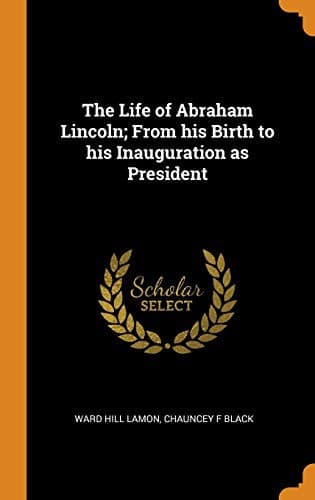
The Life of Abraham Lincoln, from His Birth to His Inauguration as PresidentLamon, Ward Hill
History
The Life of Abraham Lincoln, from His Birth to His Inauguration as President
Lamon, Ward Hill
Lincoln, Abraham, 1809-1865
The Democrats were divided into "whole-hog men" and "nominal Jackson
men;" the former being thoroughly devoted to the fortunes and principles
of their leader, while the latter were willing to trim a little for the
sake of popular support. It is probable that Mr. Lincoln might be fairly
classed as a "nominal Jackson man," although the precise character of
some of the views he then held, or is supposed to have held, on
national questions, is involved in considerable doubt. He had not wholly
forgotten Jones, or Jones's teachings. He still remembered his high
disputes with Offutt in the shanty at Spring Creek, when he effectually
defended Jackson against the "abuse" of his employer. He was not Whig,
but "Whiggish," as Dennis Hanks expresses it. It is not likely that a
man who deferred so habitually to the popular sentiment around him would
have selected the occasion of his settlement in a new place to go over
bodily to a hopeless political minority. At all events, we have at least
three undisputed facts, which make it plain that he then occupied an
intermediate position between the extremes of all parties. First, he
received the votes of all parties at New Salem; second, he was the next
year appointed postmaster by Gen. Jackson; and, third, the Democrats ran
him for the legislature two years afterwards; and he was elected by a
larger majority than any other candidate.
"Our old way of conducting elections," says Gov. Ford, "required each
aspirant to announce himself as a candidate. The most prudent, however,
always consulted a little caucus of select, influential friends. The
candidates then travelled around the county, or State, in proper
person, making speeches, conversing with the people, soliciting votes,
whispering slanders against their opponents, and defending themselves
against the attacks of their adversaries; but it was not always best
to defend against such attacks. A candidate in a fair way to be elected
should never deny any charge made against him; for, if he does, his
adversaries will prove all that they have said, and much more. As a
candidate did not offer himself as the champion of any party, he usually
agreed with all opinions, and promised every thing demanded by the
people, and most usually promised, either directly or indirectly, his
support to all the other candidates at the same election. One of the
arts was to raise a quarrel with unpopular men who were odious to the
people, and then try to be elected upon the unpopularity of others, as
well as upon his own popularity. These modes of electioneering were not
true of all the candidates, nor perhaps of half of them, very many of
them being gentlemen of first-class integrity."
Public-domain text, read in full here on John Shaqi.
Reviews
Reviews
No reviews yet
Be the first to share your thoughts on this work.
Elsewhere in the archive
Join the Discussion
Join the discussion
Sign in to leave a comment or review.
Sign InorCreate an account