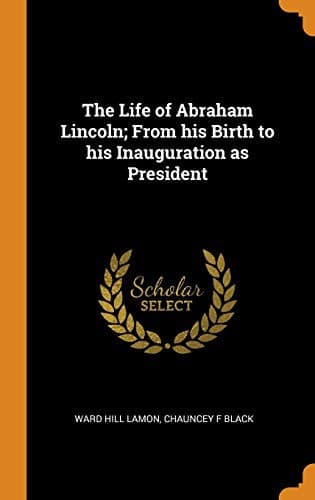
The Life of Abraham Lincoln, from His Birth to His Inauguration as PresidentLamon, Ward Hill
History
The Life of Abraham Lincoln, from His Birth to His Inauguration as President
Lamon, Ward Hill
Lincoln, Abraham, 1809-1865
Mr. Everett, then (1836) Governor of Massachusetts, informed the
Legislature, for the admonition of these unsparing agitators against
the peace of the South, that "every thing that tends to disturb the
relations created by this compact [the Constitution] is at war with its
spirit; and whatever, by direct and necessary operation, is calculated
to excite an insurrection among the slaves, has been held by highly
respectable legal authority an offence against the peace of this
Commonwealth, which may be prosecuted as a misdemeanor at common law."
It was proposed in the Legislature to pass an act defining the offence
with more certainty, and attaching to it a severer penalty. The
Abolitionists asked to be heard before the committee; and Rev. S. J.
May, Ellis Gray Loring, Prof. Charles Follen, Samuel E. Sewell, and
others of equal ability and character, spoke in their behalf. They
objected to the passage of such an act in the strongest terms, and
derided the value of a Union which could not protect its citizens in
one of their most cherished rights. During the hearing, several bitter
altercations took place between them and the chairman.
In New York, Gov. Marcy called upon the Legislature "to do what may be
done consistently with the great principles of civil liberty, to put an
end to the evils which the Abolitionists are bringing upon us and the
whole country." The "character" and the "interests" of the State were
equally at stake, and both would be sacrificed unless these furious and
cruel fanatics were effectually suppressed.
In May, 1836, the Federal House of Representatives resolved, by
overwhelming votes, that Congress had no right to interfere with slavery
in the States, or in the District of Columbia, and that henceforth all
abolition petitions should be laid on the table without being printed or
referred. And, one day later than the date of Mr. Lincoln's protest, Mr.
Van Buren declared in his inaugural, that no bill abolishing slavery
in the District of Columbia, or meddling with it in the States where it
existed, should ever receive his signature. "There was no other form,"
says Benton, "at that time, in which slavery agitation could manifest
itself, or place it could find a point to operate; the ordinance of 1787
and the compromise of 1820 having closed up the Territories against
it. Danger to slave property in the States, either by direct action,
or indirectly through the District of Columbia, were the only points of
expressed apprehension."
Abolition agitations fared little better in the twenty-fifth Congress
than in the twenty-fourth. At the extra session in September of 1837,
Mr. Slade of Vermont introduced two petitions for the abolition of
slavery in the District of Columbia; but, after a furious debate and a
stormy scene, they were disposed of by the adoption of the following:--
Public-domain text, read in full here on John Shaqi.
Reviews
Reviews
No reviews yet
Be the first to share your thoughts on this work.
Elsewhere in the archive
Join the Discussion
Join the discussion
Sign in to leave a comment or review.
Sign InorCreate an account