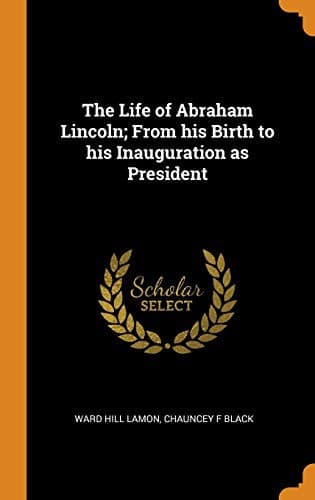
The Life of Abraham Lincoln, from His Birth to His Inauguration as PresidentLamon, Ward Hill
History
The Life of Abraham Lincoln, from His Birth to His Inauguration as President
Lamon, Ward Hill
Lincoln, Abraham, 1809-1865
gift as a sacred trust, to be administered solely for the people, and as
in no sense a fund upon which he could draw for the payment of private
accounts. He _never_ preferred his friends to his enemies, but rather
the reverse, as if fearful that he might by bare possibility be
influenced by some unworthy motive. He was singularly cautious to
avoid the imputation of fidelity to his friends at the expense of his
opponents.
In Coke's and Blackstone's time the law was supposed to be "a jealous
mistress;" but in Lincoln's time, and at Springfield, she was any
thing but exacting. Politicians courted her only to make her favor the
stepping-stone to success in other employments. Various members of that
bar have left great reputations to posterity, but none of them were
earned solely by the legitimate practice of the law. Douglas is
remembered as a statesman, Baker as a political orator, Hardin as a
soldier, and some now living, like Logan and Stuart, although eminent
in the law, will be no less known to the history of the times as
politicians than as lawyers. Among those who went to the law for a
living, and to the people for fame and power, was Mr. Lincoln. He was
still a member of the Legislature when he settled at Springfield, and
would probably have continued to run for a seat in that body as often
as his time expired, but for the unfortunate results of the
"internal-improvement system," the hopeless condition of the State
finances, and a certain gloominess of mind, which arose from private
misfortunes that befell him about the time of his retirement. We do
not say positively that these were the reasons why Mr. Lincoln made no
effort to be re-elected to the Legislature of 1840; but a careful study
of all the circumstances will lead any reasonable man to believe that
they were. He was intensely ambitious, longed ardently for place and
distinction, and never gave up a prospect which seemed to him good when
he was in a condition to pursue it with honor to himself and fairness
to others. Moreover State politics were then rapidly ceasing to be
the high-road to fame and fortune. Although the State of Illinois was
insolvent, unable to pay the interest on her public debt, and many were
talking about repudiating the principal, the great campaign of 1840 went
off upon national issues, and little or nothing was said about questions
of State policy. Mr. Lincoln felt and obeyed this tendency of the public
mind, and from 1837 onward his speeches--those that were printed and
those that were not--were devoted chiefly, if not exclusively, to
Federal affairs.
In January, 1837, he delivered a lecture before the Springfield Lyceum
on the subject of the "_Perpetuation of our Free Institutions_." As a
mere declamation, it is unsurpassed in the annals of the West. Although
delivered in mid-winter, it is instinct with the peculiar eloquence of
the most fervid Fourth of July.
Public-domain text, read in full here on John Shaqi.
Reviews
Reviews
No reviews yet
Be the first to share your thoughts on this work.
Elsewhere in the archive
Join the Discussion
Join the discussion
Sign in to leave a comment or review.
Sign InorCreate an account