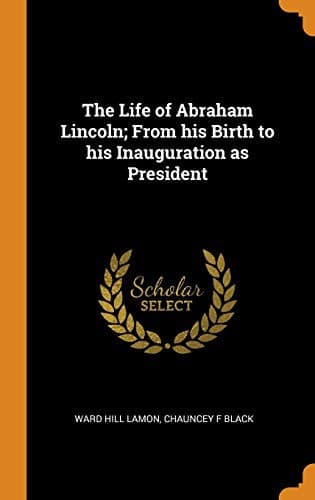
The Life of Abraham Lincoln, from His Birth to His Inauguration as PresidentLamon, Ward Hill
History
The Life of Abraham Lincoln, from His Birth to His Inauguration as President
Lamon, Ward Hill
Lincoln, Abraham, 1809-1865
In 1840 Mr. Lincoln was a candidate for presidential elector on the
Harrison ticket, and stumped a large part of the State. He and Douglas
followed Judge Treat's court all around the circuit, "and spoke in the
afternoons." The Harrison club at Springfield became thoroughly familiar
with his voice. But these one-sided affairs were not altogether suited
to his temper: through his life he preferred a joint discussion, and
the abler the man pitted against him, the better he liked it. He knew he
shone in retort, and sought every opportunity to practise it. From 1838
to 1858, he seems to have followed up Douglas as a regular business
during times of great political excitement, and only on one or two
occasions did he find the "Little Giant" averse to a conflict. Here, in
1840, they came in collision, as they did in 1839, and as they continued
to do through twenty or more years, until Lincoln became President of
the United States, and Douglas's disappointments were buried with his
body. Once during this Harrison campaign they had a fierce discussion
before a meeting assembled in the market-house. In the course of his
speech, Lincoln imputed to Van Buren the great sin of having voted
in the New York State Convention for negro suffrage with a property
qualification. Douglas denied the fact; and Lincoln attempted to prove
his statement by reading a certain passage from Holland's "Life of Van
Buren," containing a letter from Van Buren to one Mr. Fithian. Whereupon
"Douglas got mad," snatched up the book, and, tossing it into the crowd,
remarked sententiously, although not conclusively, "Damn such a book!"
"He was very sensitive," says Mr. Gillespie, "where he thought he had
failed to come up to the expectations of his friends. I remember a case.
He was pitted by the Whigs, in 1840, to debate with Mr. Douglas, the
Democratic champion. Lincoln did not come up to the requirements of the
occasion. He was conscious of his failure; and I never saw any man so
much distressed. He begged to be permitted to try it again, and was
reluctantly indulged; and in the next effort he transcended our highest
expectations. I never heard, and never expect to hear, such a triumphant
vindication as he then gave of Whig measures or policy. He never after,
to my knowledge, fell below himself."
Public-domain text, read in full here on John Shaqi.
Reviews
Reviews
No reviews yet
Be the first to share your thoughts on this work.
Elsewhere in the archive
Join the Discussion
Join the discussion
Sign in to leave a comment or review.
Sign InorCreate an account