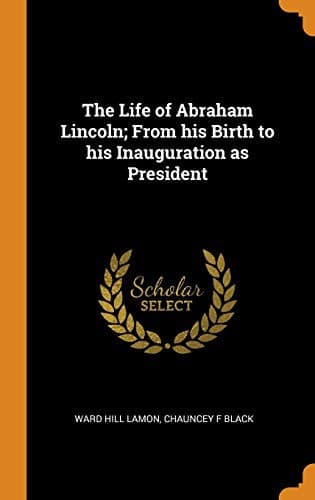
The Life of Abraham Lincoln, from His Birth to His Inauguration as PresidentLamon, Ward Hill
History
The Life of Abraham Lincoln, from His Birth to His Inauguration as President
Lamon, Ward Hill
Lincoln, Abraham, 1809-1865
Hamilton's opinion was for the power;
while Randolph's and Jefferson's were both against it. Mr. Jefferson,
in his letter dated Feb. 15, 1791, after giving his opinion decidedly
against the constitutionality of that bill, closed with the paragraph
which I now read:--
"It must be admitted, however, that, unless the President's mind, on
a view of every thing which is urged for and against this bill, is
tolerably clear that it is unauthorized by the Constitution; if the pro
and the con hang so even as to balance his judgment, a just respect
for the wisdom of the Legislature would naturally decide the balance in
favor of their opinion; it is chiefly for cases where they are clearly
misled by error, ambition, or interest, that the Constitution has placed
a check in the negative of the President."
Gen. Taylor's opinion, as expressed in his Allison letter, is as I now
read:--
"The power given by the veto is a high conservative power, but, in my
opinion, should never be exercised, except in cases of clear violation
of the Constitution, or manifest haste and want of consideration by
Congress."
It is here seen, that, in Mr. Jefferson's opinion, if, on the
constitutionality of any given bill, the President doubts, he is not to
veto it, as the gentleman from Kentucky would have him to do, but is
to defer to Congress, and approve it. And if we compare the opinions of
Jefferson and Taylor, as expressed in these paragraphs, we shall find
them more exactly alike than we can often find any two expressions
having any literal difference. None but interested fault-finders can
discover any substantial variation.
But gentlemen on the other side are unanimously agreed that Gen. Taylor
has no other principle. They are in utter darkness as to his opinions on
any of the questions of policy which occupy the public attention. But
is there any doubt as to what he will do on the prominent question, if
elected? Not the least. It is not possible to know what he will or would
do in every imaginable case, because many questions have passed away,
and others doubtless will arise, which none of us have yet thought
of; but on the prominent questions of currency, tariff, internal
improvements, and Wilmot Proviso, Gen. Taylor's course is at least as
well defined as is Gen. Cass's. Why, in their eagerness to get at Gen.
Taylor, several Democratic members here have desired to know whether, in
case of his election, a bankrupt-law is to be established. Can they tell
us Gen. Cass's opinion on this question? (Some member answered, He is
against it.") Ay, how do you know he is? There is nothing about it in
the platform, nor elsewhere, that I have seen. If the gentleman knows
any thing which I do not, he can show it. But to return: Gen. Taylor, in
his Allison letter, says,--
Public-domain text, read in full here on John Shaqi.
Reviews
Reviews
No reviews yet
Be the first to share your thoughts on this work.
Elsewhere in the archive
Join the Discussion
Join the discussion
Sign in to leave a comment or review.
Sign InorCreate an account