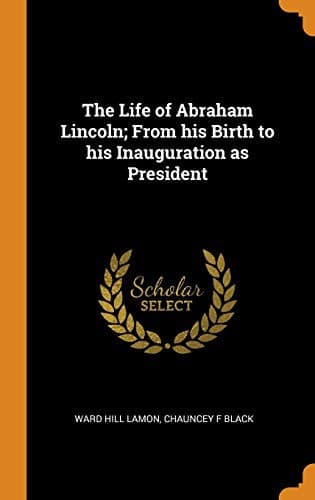
The Life of Abraham Lincoln, from His Birth to His Inauguration as PresidentLamon, Ward Hill
History
The Life of Abraham Lincoln, from His Birth to His Inauguration as President
Lamon, Ward Hill
Lincoln, Abraham, 1809-1865
Mrs. Lincoln was never able to speak of Abe's conduct to her without
tears. In her interview with Mr. Herndon, when the sands of her life had
nearly run out, she spoke with deep emotion of her own son, but said
she thought that Abe was kinder, better, truer, than the other. Even the
mother's instinct was lost as she looked back over those long years of
poverty and privation in the Indiana cabin, when Abe's grateful love
softened the rigors of her lot, and his great heart and giant frame were
always at her command. "Abe was a poor boy," said she; "and I can say
what scarcely one woman--a mother--can say in a thousand. Abe never gave
me a cross word or look, and never refused, in fact or appearance, to
do any thing I requested him. I never gave him a cross word in all
my life.... His mind and mine--what little I had--seemed to run
together.... He was here after he was elected President." (At this point
the aged speaker turned away to weep, and then, wiping her eyes with her
apron, went on with the story). "He was dutiful to me always. I think
he loved me truly. I had a son, John, who was raised with Abe. Both were
good boys; but I must say, both now being dead, that Abe was the best
boy I ever saw, or expect to see. I wish I had died when my husband
died. I did not want Abe to run for President; did not want him elected;
was afraid somehow,--felt in my heart; and when he came down to see me,
after he was elected President, I still felt that something told me that
something would befall Abe, and that I should see him no more."
Is there any thing in the language we speak more touching than that
simple plaint of the woman whom we must regard as Abraham Lincoln's
mother? The apprehension in her "heart" was well grounded. She "saw him
no more." When Mr. Herndon rose to depart, her eyes again filled with
tears; and, wringing his hands as if loath to part with one who talked
so much of her beloved Abe, she said, "Good-by, my good son's friend.
Farewell."
Abe had a very retentive memory. He frequently amused his young
companions by repeating to them long passages from the books he had been
reading. On Monday mornings he would mount a stump, and deliver, with a
wonderful approach to exactness, the sermon he had heard the day before.
His taste for public speaking appeared to be natural and irresistible.
His step-sister, Matilda Johnston, says he was an indefatigable
"preacher." "When father and mother would go to church, Abe would take
down the Bible, read a verse, give out a hymn, and we would sing. Abe
was about fifteen years of age. He preached, and we would do the crying.
Sometimes he would join in the chorus of tears. One day my brother, John
Johnston, caught a land terrapin, brought it to the place where Abe was
preaching, threw it against the tree, and crushed the shell. It suffered
much,--quivered all over. Abe then preached against cruelty to animals,
contending that an ant's life was as sweet to it as ours to us."
Public-domain text, read in full here on John Shaqi.
Reviews
Reviews
No reviews yet
Be the first to share your thoughts on this work.
Elsewhere in the archive
Join the Discussion
Join the discussion
Sign in to leave a comment or review.
Sign InorCreate an account