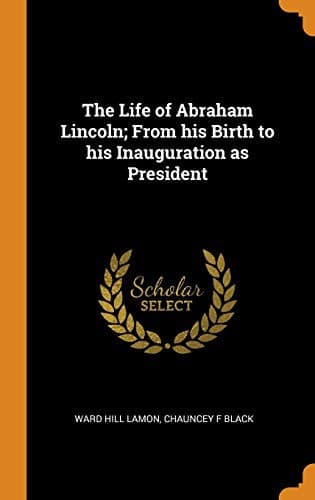
The Life of Abraham Lincoln, from His Birth to His Inauguration as PresidentLamon, Ward Hill
History
The Life of Abraham Lincoln, from His Birth to His Inauguration as President
Lamon, Ward Hill
Lincoln, Abraham, 1809-1865
wages whenever he happened to lose a few minutes from steady work.
The time came, however, when Abe got his "revenge" for all this
petty brutality. Crawford was as ugly as he was surly. His nose was a
monstrosity,--long and crooked, with a huge, misshapen "stub" at the
end, surmounted by a host of pimples, and the whole as "blue" as the
usual state of Mr. Crawford's spirits. Upon this member Abe levelled his
attack in rhyme, song, and "chronicle;" and, though he could not reduce
the nose, he gave it a fame as wide as to the Wabash and the Ohio. It is
not improbable that he learned the art of making the doggerel rhymes
in which he celebrated Crawford's nose from the study of Crawford's own
"Kentucky Preceptor." At all events, his sallies upon this single topic
achieved him great reputation as a "poet" and a wit, and caused Crawford
intolerable anguish.
It is likely that Abe was reconciled to his situation in this family by
the presence of his sister, and the opportunity it gave him of being in
the company of Mrs. Crawford, for whom he had a genuine attachment; for
she was nothing that her husband was, and every thing that he was not.
According to her account, he split rails, ploughed, threshed, and did
whatever else he was ordered to do; but she distinctly affirms that "Abe
was no hand to pitch into his work like killing snakes." He went about
it "calmly," and generally took the opportunity to throw "Crawford"
down two or three times "before they went to the field." It is fair to
presume, that, when Abe managed to inveigle his disagreeable employer
into a tussle, he hoisted him high and threw him hard, for he felt
that he had no reason to be careful of his bones. After meals Abe "hung
about," lingered long to gossip and joke with the women; and these
pleasant, stolen conferences were generally broken up with the
exclamation, "Well, this won't buy the child a coat!" and the
long-legged hired boy would stride away to join his master.
In the mean time Abe had become, not only the longest, but the
strongest, man in the settlement. Some of his feats almost surpass
belief, and those who beheld them with their own eyes stood literally
amazed. Richardson, a neighbor, declares that he could carry a load to
which the strength of "three ordinary men" would scarcely be equal. He
saw him quietly pick up and walk away with "a chicken-house, made of
poles pinned together, and covered, that weighed at least six hundred,
if not much more." At another time the Richardsons were building a
corn-crib: Abe was there; and, seeing three or four men preparing
"sticks" upon which to carry some huge posts, he relieved them of all
further trouble by shouldering the posts, single-handed, and walking
away with them to the place where they were wanted. "He could strike
with a mall," says old Mr. Wood, "a heavier blow than any man.... He
could sink an axe deeper into wood than any man I ever saw."
Public-domain text, read in full here on John Shaqi.
Reviews
Reviews
No reviews yet
Be the first to share your thoughts on this work.
Elsewhere in the archive
Join the Discussion
Join the discussion
Sign in to leave a comment or review.
Sign InorCreate an account