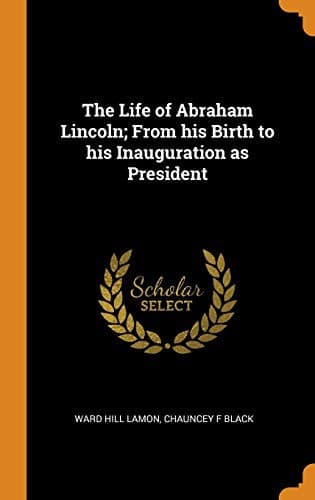
The Life of Abraham Lincoln, from His Birth to His Inauguration as PresidentLamon, Ward Hill
History
The Life of Abraham Lincoln, from His Birth to His Inauguration as President
Lamon, Ward Hill
Lincoln, Abraham, 1809-1865
Jones, the great Jones, without whom it was generally agreed that
Gentryville must have gone into eclipse, but with whom, and
through whom, it was somehow to become a sort of metropolitan
cross-roads,--Jones was Abe's friend and mentor from the moment of their
acquaintance. Abe is even said to have "clerked for him;" that is, he
packed and unpacked boxes, ranged goods on the shelves, drew the liquids
in the cellar, or exhibited the stone and earthen ware to purchasers;
but in his service he was never promoted to keeping accounts, or even to
selling the finer goods across the counter.1 But Mr. Jones was very
fond of his "clerk,"--enjoyed his company, appreciated his humor, and
predicted something great for him. As he did not doubt that Abe would
one day be a man of considerable influence, he took pains to give him
correct views of the nature of American institutions. An ardent Jackson
man himself, he imparted to Abe the true faith, as delivered by that
great democratic apostle; and the traces of this teaching were
never wholly effaced from Mr. Lincoln's mind. Whilst he remained at
Gentryville, his politics accorded with Mr. Jones's; and, even after he
had turned Whig in Illinois, John Hanks tells us that he wanted to
whip a man for traducing Jackson. He was an eager reader of newspapers
whenever he could get them, and Mr. Jones carefully put into his hands
the kind he thought a raw youth should have. But Abe's appetite was not
to be satisfied by what Mr. Jones supplied; and he frequently borrowed
others from "Uncle Wood," who lived about a mile from the Lincoln cabin,
and for whom he sometimes worked.
1 "Lincoln drove a team, cut up pork, and sold goods for
Jones. Jones told me that Lincoln read all his books, and I
remember History of United States as one. Jones often said
to me, that Lincoln would make a great man one of these
days,--had said so long before, and to other people,--said
so as far back as 1828-9.'"--Dougherty.
What manner of man kept the Gentryville grocery, we are not informed.
Abe was often at his place, however, and would stay so long at nights,
"telling stories" and "cracking jokes," that Dennis Hanks, who was
ambitious in the same line, and probably jealous of Abe's overshadowing
success, "got mad at him," and "cussed him." When Dennis found himself
thrown in the shade, he immediately became virtuous, and wished to
retire early.
Public-domain text, read in full here on John Shaqi.
Reviews
Reviews
No reviews yet
Be the first to share your thoughts on this work.
Elsewhere in the archive
Join the Discussion
Join the discussion
Sign in to leave a comment or review.
Sign InorCreate an account