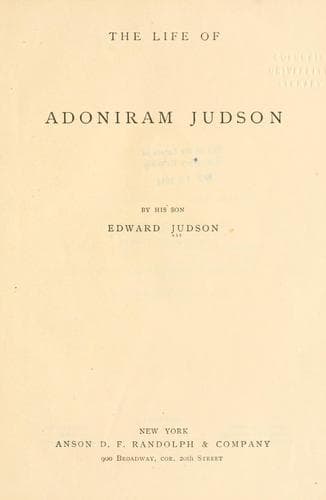
Judson, Adoniram, 1788-1850; Missionaries -- Burma -- Biography; Missionaries -- United States -- Biography
“When night came on,” writes one of Mr. Judson’s fellow-prisoners,
“the ‘Father’ of the establishment, entering, stalked toward our
corner. The meaning of the bamboo now became apparent. It was passed
between the legs of each individual, and when it had threaded our
number, seven in all, a man at each end hoisted it up by the blocks to
a height which allowed our shoulders to rest on the ground, while our
feet depended from the iron rings of the fetters. The adjustment of
the height was left to the judgment of our kind-hearted parent, who
stood by to see that it was not high enough to endanger life, nor low
enough to exempt from pain.... In the morning, our considerate parent
made his appearance, and, with his customary grin, lowered down the
bamboo to within a foot of the floor, to the great relief of our
benumbed limbs, in which the blood slowly began again to circulate.”
When Mr. Judson was subjected to these indignities and tortures, he was
in the very prime of life—thirty-six years old. He had come to that age
when a good physical constitution is thoroughly seasoned and well
qualified to endure hardship.
He had always taken the best care of his health consistent with the
performance of his multiform duties. Even before leaving America, he had
adopted the following rules: First, frequently to inhale large
quantities of air, so as to expand the lungs to the uttermost; secondly,
daily to sponge the whole body in cold water; and thirdly, and above
all, to take systematic exercise in walking.
Again, he had that tough, wiry physique which endures unexpectedly even
during prolonged crises. All this was in his favor. But, on the other
hand, he was a student, unused to suffering hardship. His naturally
vigorous constitution had been somewhat enfeebled by ten years of close
application to study in a tropical climate, and of late years had been
completely shattered by repeated blows of fever and ague. He was reared
in the cold, bracing air of New England, and during the tedious hours of
imprisonment, how often must his memory have projected the sufferings of
the Oriental jail against the background of the cool, green hillsides of
his childhood. For
... “this is truth the poet sings,
That a sorrow’s crown of sorrow is remembering happier things.”
And his was an active, methodical nature, to which the enforced idleness
of twenty-one months must have brought the keenest torture. There was
his Burman Bible unfinished, and ten years of work in Rangoon going to
pieces in his absence. He longed to be preaching the Gospel. Now that he
had at last completely mastered the native tongue, he was filled with
Jeremiah’s consuming zeal. “His word was in mine heart, as a burning
fire shut up in my bones.”
Public-domain text, read in full here on John Shaqi.
Reviews
Reviews
No reviews yet
Be the first to share your thoughts on this work.
Elsewhere in the archive
Join the Discussion
Join the discussion
Sign in to leave a comment or review.
Sign InorCreate an account