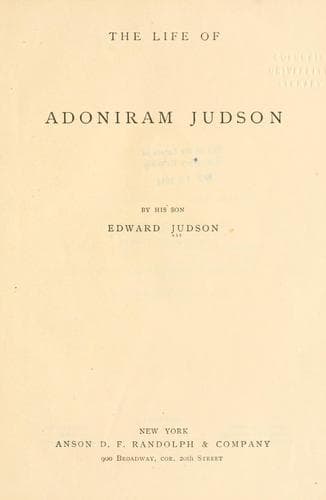
Judson, Adoniram, 1788-1850; Missionaries -- Burma -- Biography; Missionaries -- United States -- Biography
“Signals of distress were made, and a skiff sent to his assistance.
The following is the language of the writer:
“‘We were taken on board. My eyes first rested on the thin, attenuated
form of a lady—a white lady! the first white woman I had seen for more
than a year! She was standing on the little deck of the row-boat,
leaning on the arm of a sickly-looking gentleman with an intellectual
cast of countenance, in whom I at once recognized the husband or the
brother.
“‘His dress and bearing pointed him out as a missionary. I have said
that I had not beheld a white female for many months; and now the
soothing accents of female words fell upon my ears like a household
hymn of my youth.
“‘My wound was tenderly dressed, my head bound up, and I was laid upon
a sofa bed. With what a thankful heart did I breathe forth a blessing
on these kind Samaritans! With what delight did I drink in the mild,
gentle sounds of that sweet woman’s voice, as she pressed me to
recruit my strength with some of that beverage “which cheers but not
inebriates!” She was seated in a large sort of swinging chair, of
American construction, in which her slight, emaciated, but graceful
form appeared almost ethereal. Yet, with much of heaven, there were
still the breathings of earthly feeling about her, for at her feet
rested a babe, a little, wan baby, on which her eyes often turned with
all a mother’s love; and gazing frequently upon her delicate features,
with a fond yet fearful glance, was that meek missionary, her husband.
Her face was pale, very pale, with that expression of deep and serious
thought which speaks of the strong and vigorous mind within the frail
and perishing body; her brown hair was braided over a placid and holy
brow; but her hands—those small, lily hands—were quite beautiful;
beautiful they were, and very wan; for ah, they told of disease—of
death—death in all its transparent grace—when the sickly blood shines
through the clear skin, even as the bright poison lights up the
Venetian glass which it is about to shatter. That lady was Mrs.
Judson, whose long captivity and severe hardships amongst the Burmese
have since been detailed in her published journals.
“‘I remained two days with them; two delightful days they were to me.
Mrs. Judson’s powers of conversation were of the first order, and the
many affecting anecdotes that she gave us of their long and cruel
bondage, their struggles in the cause of religion, and their
adventures during a long residence at the court of Ava, gained a
heightened interest from the beautiful, energetic simplicity of her
language, as well as from the certainty I felt that so fragile a
flower as she in very truth was, had but a brief season to linger on
earth.
Public-domain text, read in full here on John Shaqi.
Reviews
Reviews
No reviews yet
Be the first to share your thoughts on this work.
Elsewhere in the archive
Join the Discussion
Join the discussion
Sign in to leave a comment or review.
Sign InorCreate an account