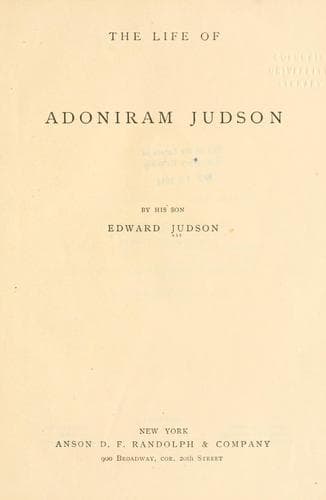
Judson, Adoniram, 1788-1850; Missionaries -- Burma -- Biography; Missionaries -- United States -- Biography
The Burman officials who had been frightened from their victims by the
discharges of artillery, again seized them, and proceeded to confine
them in a brick building. Here they were at last discovered, and rescued
by the advancing British troops. Having thus narrowly escaped martyrdom,
Mr. Hough and Mr. Wade, with their wives, embarked for Calcutta, where
they thought it best to remain until the close of the war. So when Mr.
Judson returned to Rangoon he was without a missionary associate. Mr.
Wade was ready to join him as soon as he should decide as to the best
place for renewed operations; while Mr. Hough soon after entered the
service of the British Government.
But missionary reinforcements had already come from America. Mr. Wade,
while waiting in Calcutta for the war to close, was joined by George
Dana Boardman, whose brief and saintly career was destined to make his
name peculiarly fragrant to American Christians. He seemed an ideal
missionary, so completely was he fitted for his work by his scholarly
tastes, affectionate disposition, and fervent piety. He had taken up a
newspaper a little while before, and had seen a notice of Colman’s
untimely death in Arracan. In the twinkling of an eye there flashed
through his mind the question and answer: “Who will go to fill his
place?” “_I_ will go.”
He had married Sarah Hall, a native of Salem, Massachusetts. Those who
knew her speak of “faultless features, moulded on the Grecian model,
beautiful transparent skin, warm, meek blue eyes, and soft hair, brown
in the shadow and gold in the sun.” She was pronounced by her English
friends in Calcutta to be “the most finished and faultless specimen of
an American woman that they had ever known.” From her earliest years she
had possessed an enthusiasm for missions. When ten years old, she wrote
a poem upon the death at Rangoon of Mrs. Judson’s infant Roger. Little
did the child dream that many years after she was to take the place of
the ideal heroine of her childhood, who, worn out with the prolonged
horrors of Ava and Oung-pen-la, lay down to rest beneath the hopia-tree
at Amherst.
Mr. Wade and Mr. Boardman waited anxiously in Calcutta for news from the
Judsons. They did not, however, wait in idleness. They were learning the
Burman language, as best they could, and preaching in English in the
Circular Road Baptist chapel, where they were permitted to see, as a
result of their labors, many persons converted and baptized. When news
came at last from Mr. Judson, they were ready to join him and labor
wherever he should think it best.
But to return to Mr. Judson in Rangoon. Not only did he find that the
white teachers and their wives had been driven away by the war, but the
native church membership was much reduced. He had left a church of
eighteen disciples. He found on his return only four. With the exception
of two, none, however, had disgraced their holy profession.
Public-domain text, read in full here on John Shaqi.
Reviews
Reviews
No reviews yet
Be the first to share your thoughts on this work.
Elsewhere in the archive
Join the Discussion
Join the discussion
Sign in to leave a comment or review.
Sign InorCreate an account