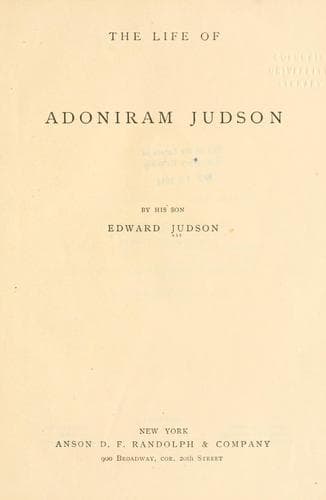
Judson, Adoniram, 1788-1850; Missionaries -- Burma -- Biography; Missionaries -- United States -- Biography
But before missionary operations were fairly begun, Mr. Judson was
compelled reluctantly to visit Ava, the scene of his imprisonment. The
English Government desired to negotiate a commercial treaty with the
Burman king; and Mr. Crawfurd, the Civil Commissioner of the newly-ceded
provinces, was appointed envoy. He invited Mr. Judson to accompany him
as a member of the embassy. The missionary’s profound knowledge of the
Burman language and character well qualified him for the delicate and
difficult task of treating with the court at Ava. At first he firmly
declined. He had no relish for diplomatic occupation, and he longed to
plunge again into his own work. But when he was assured that, if he
would go as an English ambassador, every effort would be made to secure
the insertion of a clause in the treaty granting religious liberty to
the Burmans, so that the whole country would be thrown open to the
Gospel, he reluctantly consented. The stubborn intolerance of the native
Government had hitherto been the chief obstacle in his missionary work,
and religious freedom for the Burmese was a blessing for which he had
long prayed and striven in vain.
This step, which proved to be a most unfortunate one, was, however, the
result of the most mature deliberation. Mr. Judson with the English
embassy arrived in Ava September 30, 1826, and remained there about two
months and a half. This period embraces one of the saddest episodes of
his life. He was forced to witness the scene of his prolonged sufferings
in prison, and yet was separated from the wife and babe who had shared
with him those horrible experiences. He was engaged in the tedious and
uncongenial task of wrestling as a diplomat with the stupidity and
intolerance of the Burmese court. He soon learned that the king would on
no terms agree to a clause in the treaty granting his subjects freedom
of worship. And to crown his sorrows, on the 4th of November there was
placed in his hands a sealed letter, containing the intelligence that
Mrs. Judson was no more!
After the departure of her husband for Amherst, she had begun her work
with good heart. She built a little bamboo dwelling-house and two
school-houses. In one of these she gathered ten Burman children who were
placed under the instruction of faithful Moung Ing; while she herself
assembled the few native converts for public worship every Sunday. At
one time she writes:
“My female school will, I trust, soon be in operation. Then you shall
hear from me constantly.”
And again:
“After all the impediments which have retarded the progress of our
mission, after all our sufferings and afflictions, I can not but hope
that God has mercy and a blessing in store for us. Let us strive to
obtain it by our prayers and holy life.”
Public-domain text, read in full here on John Shaqi.
Reviews
Reviews
No reviews yet
Be the first to share your thoughts on this work.
Elsewhere in the archive
Join the Discussion
Join the discussion
Sign in to leave a comment or review.
Sign InorCreate an account