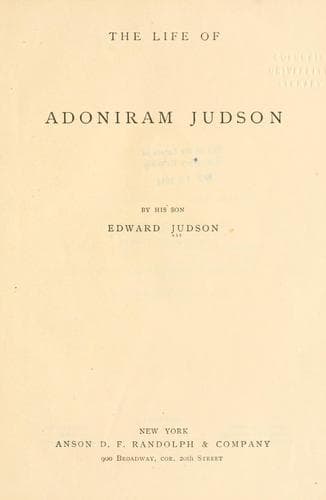
Judson, Adoniram, 1788-1850; Missionaries -- Burma -- Biography; Missionaries -- United States -- Biography
After all, it was his intense piety that carried him into these extremes
of self-denial. His was a great religious nature, wrestling for
Christ-likeness. A small and weak nature always keeps within limit. Soil
that is too thin for grain, never produces weeds. From the time that Mr.
Judson gave his heart to God at Andover, he was possessed with a
consuming zeal to be made holy. On this point, Mrs. E. C. Judson says:
“I was first attracted by the freshness, the _originality_, if I may so
call it, of his goodness.”... “His religion mingled in his letters
generally, and in his conversation—a little silver thread that it is
impossible to disentangle.”
He was a man of prayer. His habit was to walk while engaged in private
prayer. One who knew him most intimately says that “His best and freest
time for meditation and prayer was while walking rapidly in the open
air. He, however, attended to the duty in his room, and so well was this
peculiarity understood that when the children heard a somewhat heavy,
quick, but well-measured tread, up and down the room, they would say,
‘Papa is praying.’”
“His was the life,” one writes, “of what the English would call ‘a good
fellow,’ elevated and purified and beautified by religion.” Though he
was a most brilliant and genial companion, yet, in his mind, every
social relation was a tie by which men might be drawn heavenward. When
Sir Archibald Campbell, the hero of the first Burman war, was on the eve
of setting sail for his native land, crowned with the laurels of
victory, he received from the lips of the humble and faithful ambassador
of the cross, whom he had befriended, the following tender and solemn
words of Christian admonition:
“MAULMAIN, _January_ 8, 1829.
“MY DEAR SIR: A few days ago I heard of your intention to leave this
place on your return home.
“When I reflect on your many kindnesses to me and my beloved wife,
now, I trust, in heaven, from the time I first saw you at Yebbay to
the present moment, and on the many pleasant interviews with which I
have been honored, it is natural that I should feel a desire to
express my gratitude for your goodness, and my regret at your
departure. But, besides that desire, I have, for a few days, had an
impression on my mind which I can not avoid, and dare not counteract.
I would fain say a few words to you on a subject which you have
probably never had a friend faithful enough to present plainly to your
mind. I feel that I write under the influence of a higher power; and I
beg that if my words offend you, you will still have the charity to
believe that I am influenced by none other than the most
disinterested, affectionate, and respectful sentiments. And though you
should at first be displeased, I can not but hope that you will
sometimes suffer the question to intrude on your most retired moments,
whether the words I speak are not the words of eternal truth.
Public-domain text, read in full here on John Shaqi.
Reviews
Reviews
No reviews yet
Be the first to share your thoughts on this work.
Elsewhere in the archive
Join the Discussion
Join the discussion
Sign in to leave a comment or review.
Sign InorCreate an account