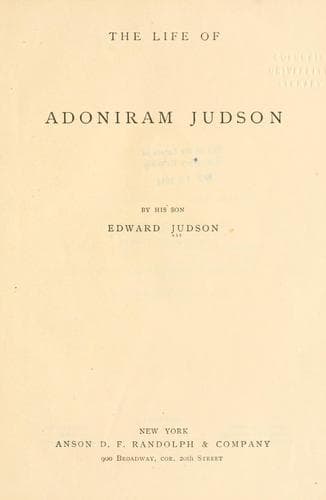
Judson, Adoniram, 1788-1850; Missionaries -- Burma -- Biography; Missionaries -- United States -- Biography
Again, Mr. Judson had a very strong relish for literature and linguistic
research. One can not fail to observe the poetic gems, original and
quoted, scattered through his correspondence. The Burman literature,
with its Buddhistic books and its fascinating poetry, was a vast mine
unexplored. He was tempted to trace the winding paths which were ever
opening before his scholarly mind, and to search this great and ancient
treasure-vault. Might he not translate into English some beautiful
fragments of this literature, and so enkindle in some of the
highly-organized minds of the Western world a greater interest in
foreign missions? But no. He turned resolutely away from the alluring
prospect. He was determined not to know anything among the Burmans save
Jesus Christ and Him crucified. As a missionary he was unwilling to
disperse his mental forces over the wide surface of literary and
philosophical pursuit, but insisted on moving along the narrow and
divinely-appointed groove of unfolding the word of God and meting it out
to suit the wants of perishing man.
But perhaps the severest sacrifice of all was the denial of his social
instincts. It was not because he was unendowed with social sensibility
that he so cut himself off from the State or conventional dinner and
from a fashionable intercourse with Sir Archibald Campbell, and other
cultivated Englishmen, as to incur the stigma of being called “odd.” He
did not withdraw to his hermitage in the jungle because he was a fierce
and sullen fanatic. On the contrary, one who knew him most intimately
says that “Perhaps his most remarkable characteristic to a superficial
observer was the extent and thoroughly genial nature of his
sociableness.” Indeed, there was a spice of truth in the remark
sneeringly made by a fashionable woman that “Judson abstained from
society not from principle, but from cowardice—he was like the drunkard
who was afraid to taste lest he should not know when to stop.” “His
ready humor,” Mrs. Judson writes, “his aptness at illustration, his free
flow of generous, gentlemanly feeling made his conversation peculiarly
brilliant and attractive, and such interchanges of thought and feeling
were his delight.” “He was not,” she adds, “a born angel, shut without
the pale of humanity by his religion.” His was not the stern, unæsthetic
nature of the great reformer and theologian who, though he lived his
life on the Lake of Geneva, nowhere betrays, in his voluminous writings,
that he was at all conscious of the beautiful panorama spread out before
him. He was, as has been said of another, “a creature who entered into
every one’s feelings, and could take the pressure of their thought
instead of urging his own with iron resistance.” He was, in truth,
“... Not too bright or good
For human nature’s daily food;
For transient sorrows, simple wiles,
Praise, blame, love, kisses, tears, and smiles.”
Public-domain text, read in full here on John Shaqi.
Reviews
Reviews
No reviews yet
Be the first to share your thoughts on this work.
Elsewhere in the archive
Join the Discussion
Join the discussion
Sign in to leave a comment or review.
Sign InorCreate an account