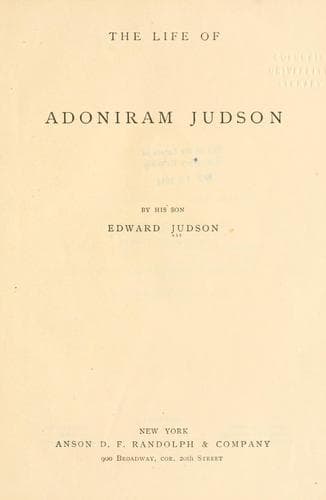
Judson, Adoniram, 1788-1850; Missionaries -- Burma -- Biography; Missionaries -- United States -- Biography
“Infinite love, my dear sister, in the person of the Lord Jesus, is
even now looking down upon you, and will smile if you offer Him your
bleeding, breaking heart. All created excellence and all ardor of
affection proceed from Him. He loves you far more than you love your
children; and He loves them also, when presented in the arms of faith,
far more than you can conceive. Give them up, therefore, to His tender
care. He will, I trust, restore them to you under greater advantages,
and united to Himself; and you, who now sow in tears, shall reap in
joy. And on the bright plains of heaven they shall dwell in your arms
forever, and you shall hear their celestial songs, sweetened and
heightened by your present sacrifices and tears.
“Yours, A. JUDSON.”
Again he writes to the same bereaved lady:
“What a miserable world is this! No sooner does the heart’s pulse
begin to take a little hold, than snap it goes. How many times more
shall I have to sing that melancholy ditty—
“‘Had we never loved so kindly,
Had we never loved so blindly,
Never met, or never parted,
We had ne’er been broken-hearted!’
Even those poor culprits, Elsina and Mary, do so frequently squeeze
out the tear, that it is painful to think of them. I don’t wonder that
you say your heart is ready to break. I almost wonder how you can
breathe. And I don’t think that Mrs. Wade’s sweet, but cruel letters
have helped the matter at all. But be patient, poor soul! Heaven will
be sweeter for all this, though you may be unwilling to believe it.
And we have every reason to pray and to hope that the dear absent ones
will be with you to all eternity.”
From what has been written on the subject of _Guyonism_, it can easily
be seen how near at one period of his life, under the stress of grief
and physical enfeeblement, Mr. Judson approached the perilous verge of
fanaticism. He, however, soon recovered his mental and spiritual
equilibrium, and in the busy whirl of missionary activity, and later in
the formation of new social and domestic relations, threw off whatever
excesses may temporarily have characterized his views and practices of
self-denial. We subjoin a fragment, probably a scrap torn from the close
of a letter:
“Leaving one party to prove that the standard of Christian morality is
lowered since the days of the apostles, and another party to assert
and expect the restoration of miraculous powers, let us adopt a middle
course, the golden medium—HOLY AS THE APOSTLES, WITHOUT THEIR
POWER—and then ‘the glory of this latter house shall be greater than
that of the former.’”
Public-domain text, read in full here on John Shaqi.
Reviews
Reviews
No reviews yet
Be the first to share your thoughts on this work.
Elsewhere in the archive
Join the Discussion
Join the discussion
Sign in to leave a comment or review.
Sign InorCreate an account