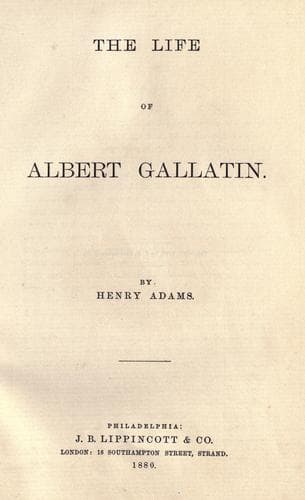
What Hamilton was to Washington, Gallatin was to Jefferson, with only
such difference as circumstances required. It is true that the powerful
influence of Mr. Madison entered largely into the plan of Jefferson's
Administration, uniting and modifying its other elements, and that this
was an influence the want of which was painfully felt by Washington and
caused his most serious difficulties; it is true, too, that Mr.
Jefferson reserved to himself a far more active initiative than had been
in Washington's character, and that Mr. Gallatin asserted his own
individuality much less conspicuously than was done by Mr. Hamilton; but
the parallel is nevertheless sufficiently exact to convey a true idea of
Mr. Gallatin's position. The government was in fact a triumvirate almost
as clearly defined as any triumvirate of Rome. During eight years the
country was governed by these three men,--Jefferson, Madison, and
Gallatin,--among whom Gallatin not only represented the whole political
influence of the great Middle States, not only held and effectively
wielded the power of the purse, but also was avowedly charged with the
task of carrying into effect the main principles on which the party had
sought and attained power.
In so far as Mr. Jefferson's Administration was a mere protest against
the conduct of his predecessor, the object desired was attained by the
election itself. In so far as it represented a change of system, its
positive characteristics were financial. The philanthropic or
humanitarian doctrines which had been the theme of Mr. Jefferson's
philosophy, and which, in a somewhat more tangible form, had been put
into shape by Mr. Gallatin in his great speech on foreign intercourse
and in his other writings, when reduced to their simplest elements
amount merely to this: that America, standing outside the political
movement of Europe, could afford to follow a political development of
her own; that she might safely disregard remote dangers; that her
armaments might be reduced to a point little above mere police
necessities; that she might rely on natural self-interest for her
foreign commerce; that she might depend on average common sense for her
internal prosperity and order; and that her capital was safest in the
hands of her own citizens. To establish these doctrines beyond the
chance of overthrow was to make democratic government a success, while
to defer the establishment of these doctrines was to incur the risk, if
not the certainty, of following the career of England in "debt,
corruption, and rottenness."
Public-domain text, read in full here on John Shaqi.
Reviews
Reviews
No reviews yet
Be the first to share your thoughts on this work.
Elsewhere in the archive
Join the Discussion
Join the discussion
Sign in to leave a comment or review.
Sign InorCreate an account