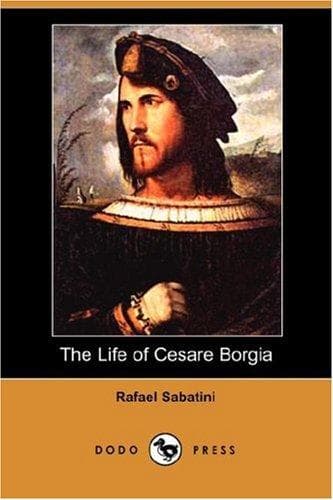
Meanwhile his forces grew daily in Rome, and his time was consumed in
organizing, equipping, and drilling these, to bring about that perfect
unity for which his army was to be conspicuous in spite of the variety
of French, Italian, Spanish, and Swiss elements of which it was
composed. So effectively were his troops armed and so excellent was the
discipline prevailing among them, that their like had probably never
before been seen in the peninsula, and they were to excite--as much
else of Cesare’s work--the wonder and admiration of that great critic
Macchiavelli.
So much, however, was not to be achieved without money, and still more
would be needed for the campaign ahead. For this the Church provided.
Never had the coffers of the Holy See been fuller than at this moment.
Additional funds accrued from what is almost universally spoken of as
“the sale of twelve cardinals’ hats.”
In that year--in September--twelve new cardinals were appointed, and
upon each of those was levied, as a tax, a tithe of the first year’s
revenues of the benefices upon which they entered. The only justifiable
exception that can be taken to this lies in the number of cardinals
elected at one time, which lends colour to the assumption that the
sole aim of that election was to raise additional funds for Cesare’s
campaign. Probably it was also Alexander’s aim further to strengthen his
power with the Sacred College, so that he could depend upon a majority
to ensure his will in all matters. But we are at the moment concerned
with the matter of the levied tax.
It has been dubbed “an atrocious act of simony;” but the reasoning that
so construes it is none so clear. The cardinals’ hats carried with them
vast benefices. These benefices were the property of the Church; they
were in the gift and bestowal of the Pope, and in the bestowing of them
the Pope levied a proportionate tax. Setting aside the argument that
this tax was not an invention of Alexander’s, does such a proceeding
really amount to a “sale” of benefices? A sale presupposes bargaining, a
making of terms between two parties, an adjusting of a price to be paid.
There is evidence of no such marketing of these benefices; indeed one
cardinal, vowed to poverty, received his hat without the imposition of a
tax, another was Cesare’s brother-in-law, Amanieu d’Albret, who had been
promised the hat a year ago. It is further to be borne in mind that,
four months earlier, the Pope had levied a similar decima, or tax, upon
the entire College of Cardinals and every official in the service of the
Holy See, for the purposes of the expedition against the Muslim, who was
in arms against Christianity. Naturally that tax was not popular with
luxurious, self-seeking, cinquecento prelates, who in the main
cared entirely for their own prosperity and not at all for that of
Christianity, and you may realize how, by levying it, Alexander laid
himself open to harsh criticism.
Public-domain text, read in full here on John Shaqi.
Reviews
Reviews
No reviews yet
Be the first to share your thoughts on this work.
Elsewhere in the archive
Join the Discussion
Join the discussion
Sign in to leave a comment or review.
Sign InorCreate an account