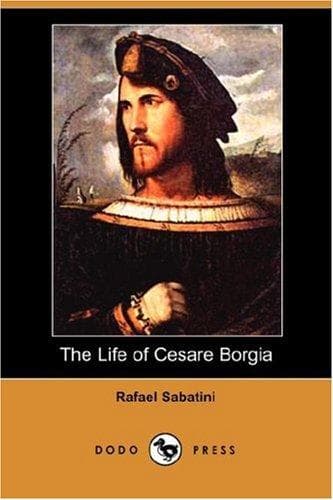
It was during this sojourn of Cesare’s at Imola that the abduction took
place of Dorotea Caracciolo, the young wife of Gianbattista Caracciolo,
a captain of foot in the Venetian service. The lady, who was attached to
the Duchess of Urbino, had been residing at the latter’s Court, and in
the previous December Caracciolo had begged leave of the Council of Ten
that he might himself go to Urbino for the purpose of escorting her to
Venice. The Council, however, had replied that he should send for her,
and this the captain had done. Near Cervia, on the confines of the
Venetian territory, towards evening of February 14, the lady’s escort
was set upon by ten wellarmed men, and rudely handled by them, some
being wounded and one at least killed, whilst the lady and a woman who
was with her were carried off.
The Podestá of Cervia reported to the Venetian Senate that the abductors
were Spaniards of the army of the Duke of Valentinois, and it was feared
in Venice--according to Sanuto--that the deed might be the work of
Cesare.
The matter contained in that Relation of Capello’s to the Senate must
by now have been widespread, and of a man who could perpetrate the
wickednesses therein divulged anything could be believed. Indeed, it
seems to have followed that, where any act of wickedness was brought to
light, at once men looked to see if Cesare might not be responsible,
nor looked close enough to make quite sure. To no other cause can it be
assigned that, in the stir which the Senate made, the name of Cesare
was at once suggested as that of the abductor, and this so broadly that
letters poured in upon him on all sides begging him to right this
cruel wrong. So much do you see assumed, upon no more evidence than
was contained in that letter from the Podestá of Cervia, which went no
further than to say that the abductors were “Spaniards of the Duke of
Valentinois’ army.” The envoy Manenti was dispatched at once to Cesare
by the Senate, and he went persuaded, it is clear, that Cesare Borgia
was the guilty person. He enlisted the support of Monsieur de Trans (the
French ambassador then on his way to Rome) and that of Yves d’Allègre,
and he took them with him to the Duke at Imola.
Public-domain text, read in full here on John Shaqi.
Reviews
Reviews
No reviews yet
Be the first to share your thoughts on this work.
Elsewhere in the archive
Join the Discussion
Join the discussion
Sign in to leave a comment or review.
Sign InorCreate an account