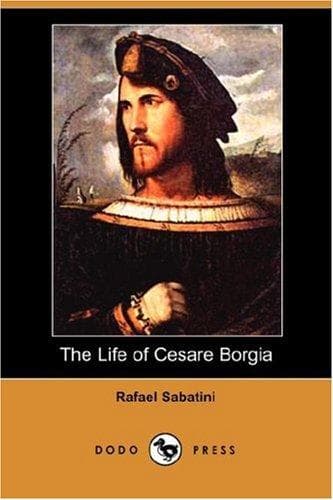
But Macchiavelli, in Cesare Borgia’s presence, is overawed by his
greatness, his force and his intellect, and these attributes engage him
in his dispatches. These same dispatches are a stumbling-block to all
who prefer to tread the beaten, sensational track, and to see in
Cesare Borgia a villain of melodrama, a monster of crime, brutal, and,
consequently, of no intellectual force. But Villari contrives to step
more or less neatly, if fatuously, over that formidable obstacle, by
telling you that Macchiavelli presents to you not really Cesare Borgia,
but a creation of his own intellect, which he had come to admire. It
is a simple, elementary expedient by means of which every piece of
historical evidence ever penned may be destroyed--including all that
which defames the House of Borgia.
Macchiavelli arrived at Imola on the evening of October 7, 1502, and,
all travel-stained as he was, repaired straight to the duke, as if
the message with which he was charged was one that would not brook a
moment’s delay in its deliverance. Actually, however, he had nothing to
offer Cesare but the empty expressions of Florence’s friendship and
the hopes she founded upon Cesare’s reciprocation. The crafty young
Florentine--he was thirty-three at the time--was sent to temporize and
to avoid committing himself or his Government.
Valentinois listened to the specious compliments, and replied by similar
protestations and by reminding Florence how he had curbed the hand
of those very condottieri who had now rebelled against him as a
consequence. He showed himself calm and tranquil at the loss of Urbino,
telling Macchiavelli that he “had not forgotten the way to reconquer
it,” when it should suit him. Of the revolted condottieri he
contemptuously said that he accounted them fools for not having known
how to choose a more favourable moment in which to harm him, and that
they would presently find such a fire burning under their feet as would
call for more water to quench it than such men as these disposed of.
Meanwhile, the success of those rustics of Urbino who had risen, and
the ease of their victories, had fired others of the territory to follow
their example. Fossombrone and Pergola were the next to rebel and to put
the Borgia garrisons to the sword; but, in their reckless audacity,
they chose their moment ill, for Michele da Corella was at hand with his
lances, and, although his orders had been to repair straight to Pesaro,
he ventured to depart from them to the extent of turning aside to punish
the insurgence of those towns by launching his men-at-arms upon them and
subjecting them to an appalling and pitiless sack.
When Cesare heard the news of it and the details of the horrors that had
been perpetrated, he turned, smiling cruelly, to Macchiavelli, who
was with him, and, “The constellations this year seem unfavourable to
rebels,” he observed.
Public-domain text, read in full here on John Shaqi.
Reviews
Reviews
No reviews yet
Be the first to share your thoughts on this work.
Elsewhere in the archive
Join the Discussion
Join the discussion
Sign in to leave a comment or review.
Sign InorCreate an account