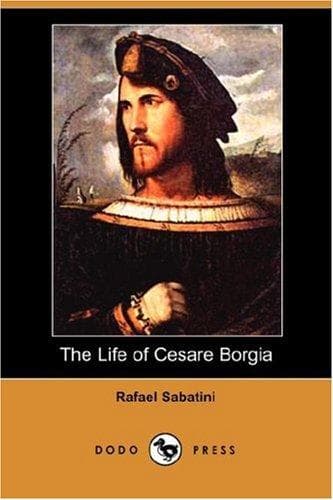
Meanwhile, sick almost to the point of death, and scarce able to stir
hand or foot, so weak in body had he been left by the heroic treatment
to which he had submitted, Cesare continued mentally a miracle of energy
and self-possession. He issued orders for the fortifying of the Vatican,
and summoned from Romagna 200 horse and 1,000 foot to his aid in Rome,
bidding Remolino, who brought these troops, to quarter himself at
Orvieto, and there await his further orders.
Considering that the Colonna were fighting in Naples under the banner
of Gonzalo de Cordoba, it was naturally enough supposed, from Cesare’s
alliance with the former, that this time he was resolved to go over to
the side of Spain. Of this, M. de Trans came to protest to Valentinois
on behalf of Louis XII, to be answered by the duke’s assurances that the
alliance into which he had entered was strictly confined to the Colonna,
that it entailed no treaty with Spain; nor had he entered into any; that
his loyalty to the King of France continued unimpaired, and that he
was ready to support King Louis with the entire forces he disposed
of, whenever his Majesty should desire him so to do. In reply, he
was assured by the French ambassador and Cardinal Sanseverino of the
continued protection of Louis, and that France would aid him to maintain
his dominions in Italy and reconquer any that might have seceded; and
of this declaration copies were sent to Florence, Venice, and Bologna on
September 1, as a warning to those Powers not to engage in anything to
the hurt of Valentinois.
Thus sped the time of the novendiali--the nine days’ obsequies of the
dead Pope--which were commenced on September 4.
As during the conclave that was immediately to follow it was against
the law for armed men to be in Rome, Cesare was desired by the Sacred
College to withdraw his troops. He did so on September 2, and himself
went with them.
Cardinal Sanseverino and the French ambassador escorted him out of Rome
and saw him take the road to Nepi--a weak, fever-ravaged, emaciated man,
borne in a litter by a dozen of his halberdiers, his youth, his beauty,
his matchless strength of body all sapped from him by the insidious
disease which had but grudgingly spared his very life.
At Nepi he was awaited by his brother Giuffredo, who had preceded him
thither from Rome. A shadowy personage this Giuffredo, whose unimportant
personality is tantalizingly elusive in the pages where mention is made
of him. His incontinent wife, Doña Sancia, had gone to Naples under the
escort of Prospero Colonna, having left the Castle of Sant’ Angelo where
for some time she had been confined by order of her father-in-law, the
Pope, on account of the disorders of her frivolous life.
And now the advices of the fresh treaty between Cesare Borgia and the
King of France were producing their effect upon Venice and Florence, who
were given additional pause by the fierce jealousy of each other, which
was second only to their jealousy of the duke.
Public-domain text, read in full here on John Shaqi.
Reviews
Reviews
No reviews yet
Be the first to share your thoughts on this work.
Elsewhere in the archive
Join the Discussion
Join the discussion
Sign in to leave a comment or review.
Sign InorCreate an account