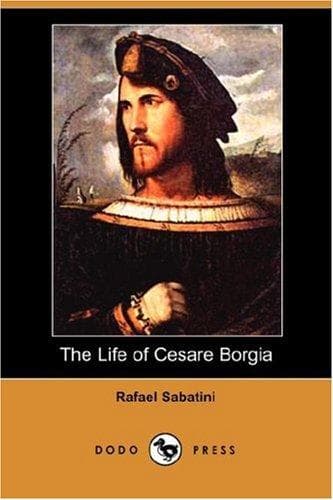
On November 26, Remolino, who had been at Ostia with Cesar; came to
Rome, and, throwing himself at the feet of the Pontiff, begged for mercy
for his lord, whom he now accounted lost. He promised Julius that Cesare
should give him the countersigns of the strongholds, together with
security for their surrender. This being all that the Pope could desire,
he issued orders that Cesare be brought back to Rome, and in Consistory
advised the Sacred College--by way, no doubt, of exculpating himself
to men who knew that he was refusing to pay the price at which he had
bought the Papacy--that the Venetians in the Romagna were not moving
against the Church, but against Cesare himself--wherefore he had
demanded of Cesare the surrender of the towns he held, that thus there
might be an end to the war.
It was specious--which is the best that can be said for it.
As for putting an end to the war, the papal brief was far indeed from
achieving any such thing, as was instantly plain from the reception it
met with in the Romagna, which persisted in its loyalty to Cesare in
despite of the very Pope himself. When that brief was read in Cesena a
wild tumult ensued, and the people ran through the streets clamouring
angrily for their duke.
It was very plain what short work would have been made of such men as
the Ordelaffi and the Malatesta had Cesare gone north. But Cesare was
fast at the Vatican, treated by the Pope with all outward friendliness
and consideration, but virtually a prisoner none the less. Julius
continued to press for the surrender of the Romagna strongholds,
which Remolino had promised in his master’s name; but Cesare persisted
obstinately to refuse, until the news reached him that Michele da
Corella and della Volpe, who had gone north with seven hundred horse to
support his Romagnuoli, had been cut to pieces in Tuscany by the army of
Gianpaolo Baglioni.
Cesare bore his burning grievance to the Pope. The Pope sympathized with
him most deeply; then went to write a letter to the Florentines to
thank them for what had befallen and to beg them to send him Michele
da Corella under a strong escort--that redoubtable captain having been
taken prisoner together with della Volpe.
Corella was known to be fully in the duke’s confidence, and there were
rumours that he was accused of many things perpetrated on the duke’s
behalf. Julius, bent now on Cesare’s ruin, desired to possess himself
of this man in the hope of being able to put him upon his trial under
charges which should reflect discredit upon Cesare.
At last the duke realized that he was betrayed, and that all was
lost, and so he submitted to the inevitable, and gave the Pope the
countersigns he craved. With these Julius at once dispatched an envoy
into the Romagna, and, knowing the temper of Cesare’s captains, he
insisted that this envoy should be accompanied by Piero d’Orvieto, as
Cesare’s own commissioner, to demand that surrender.
Public-domain text, read in full here on John Shaqi.
Reviews
Reviews
No reviews yet
Be the first to share your thoughts on this work.
Elsewhere in the archive
Join the Discussion
Join the discussion
Sign in to leave a comment or review.
Sign InorCreate an account