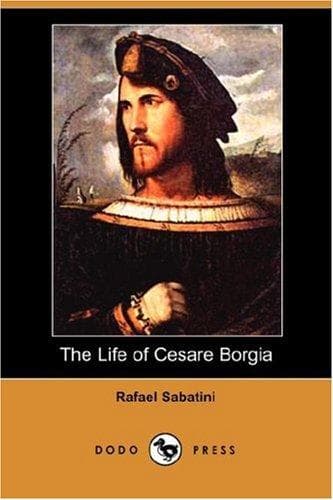
Cesare Borgia, landless, without right to any title, he that had held so
many, betrayed and abandoned on every side, had now nothing to offer in
the world’s market but his stout sword and his glad courage. These went
to the first bidder for them, who happened to be his brother-in-law King
Jean.
Navarre at the time was being snarled and quarrelled over by France and
Spain, both menacing its independence, each pretending to claims upon it
which do not, in themselves, concern us.
In addition, the country itself was torn by two factions--the Beaumontes
and the Agramontes--and it was entrusted to Cesare to restore Navarre
to peace and unity at home before proceeding--with the aid upon which
he depended from the Emperor Maximilian--to deal with the enemies beyond
her frontiers.
The Castle of Viana was being held by Louis de Beaumont--chief of the
faction that bore his name--and refused to surrender to the king.
To reduce it and compel Beaumont to obedience went Cesare as
Captain-General of Navarre, early in February of 1507. He commanded a
considerable force, some 10,000 strong, and with this and his cannon he
laid siege to the citadel.
The natural strength of the place was such as might have defied any
attempt to reduce it by force; but victuals were running low, and there
was every likelihood of its being speedily starved into surrender. To
frustrate this, Beaumont conceived the daring plan of attempting to send
in supplies from Mendavia. The attempt being made secretly, by night and
under a strong escort, was entirely successful; but, in retreating, the
Beaumontese were surprised in the dawn of that February morning by a
troop of reinforcements coming to Cesare’s camp. These, at sight of the
rebels, immediately gave the alarm.
The most hopeless confusion ensued in the town, where it was at once
imagined that a surprise attack was being made upon the Royalists, and
that they had to do with the entire rebel army.
Cesare, being aroused by the din and the blare of trumpets calling men
to arms, sprang for his weapons, armed himself in haste, flung himself
on a horse, and, without pausing so much as to issue a command to his
waiting men-at-arms, rode headlong down the street to the Puerta del
Sol. Under the archway of the gate his horse stumbled and came down with
him. With an oath, Cesare wrenched the animal to its feet again, gave
it the spur, and was away at a mad, furious gallop in pursuit of the
retreating Beaumont rearguard.
The citizens, crowding to the walls of Viana, watched that last reckless
ride of his with amazed, uncomprehending eyes. The peeping sun caught
his glittering armour as he sped, so that of a sudden he must have
seemed to them a thing of fire--meteoric, as had been his whole life’s
trajectory which was now swiftly dipping to its nadir.
Public-domain text, read in full here on John Shaqi.
Reviews
Reviews
No reviews yet
Be the first to share your thoughts on this work.
Elsewhere in the archive
Join the Discussion
Join the discussion
Sign in to leave a comment or review.
Sign InorCreate an account