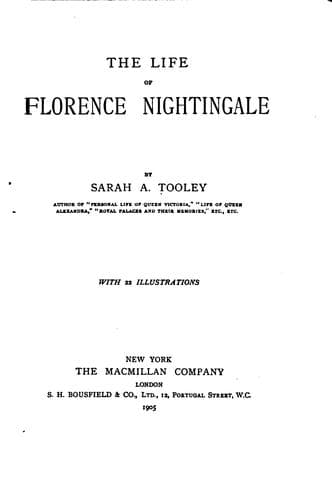
Nightingale, Florence, 1820-1910; Nurses -- England -- Biography
Miss Nightingale had probably the best first-hand knowledge of any
person in the country of the ills to which the soldiers in camp and
hospital were subjected during active warfare, and the wealth of her
experience and knowledge were given to Mr. Sidney Herbert when he
started on his campaign of reform.
We have already seen the marvellous change which Miss Nightingale had
been instrumental in bringing about in the military hospitals in the
East, and the useful work she had accomplished during the last months
in the Crimea by providing useful occupation and recreation for the
convalescent soldiers and the men in camp, and by furthering reforms in
the cooking and diet of the soldiers. The war was ended, the army was
home again, and it now remained to see that the men who took up arms
for their country should have their lives protected by the ordinary
rules of health and sanitation, and that they should be educated,
encouraged to live like self-respecting citizens of the Empire for
which they fought, and that their wives and children should be cared
for. Our heroine was not actuated by mere passing emotions easily
roused and as readily quieted. Florence Nightingale had sacrificed
her own health to cure the ills arising from the soldiers’ neglected
condition and now turned her attention to prevention.
The horrors of the Crimean War impelled Sidney Herbert to concentrate
his attention on army reform, a matter upon which he had been engaged
before the outbreak of hostilities. Now he returned to it with
redoubled vigour. Barracks as well as hospitals must be reorganised,
the soldier preserved in health as well as tended in sickness. There
must be good sanitary regulations, improved military cookery, and the
soldier must have some enjoyment in life.
Mr. Sydney Herbert had to endure his share of blame with the other
members of Lord Aberdeen’s Government for the terrible sufferings
of the troops during the Crimean War, but for which in the light of
history no one seemed less to blame than he, if blame there was, and
he atoned for it now by a long penance of work for the good of the
soldier. For every man who had perished in those bitter trenches before
Sebastopol, died in the ill-fed camps of hunger or disease, or groaned
his life away in the crowded and pestilential hospitals, Sidney Herbert
saved at least the life of one British soldier by his labours.
He was the mainspring of the Royal Commission which, after the return
of the troops from the Crimea, was appointed to inquire into the
sanitary condition of the army, and on his suggestion and with his
assistance four supplementary Commissions were issued on the subjects
of Hospitals and Barracks, Army Medical Department, Army Medical
Statistics, and on a Medical School at Chatham, and he drafted the
code of regulations for the Army Medical Department which appeared in
October, 1859.
Public-domain text, read in full here on John Shaqi.
Reviews
Reviews
No reviews yet
Be the first to share your thoughts on this work.
Elsewhere in the archive
Join the Discussion
Join the discussion
Sign in to leave a comment or review.
Sign InorCreate an account